The Subliminal Edge: When Direction, Focus, and Execution Converge

The Subliminal Edge: When Direction, Focus, and Execution Converge
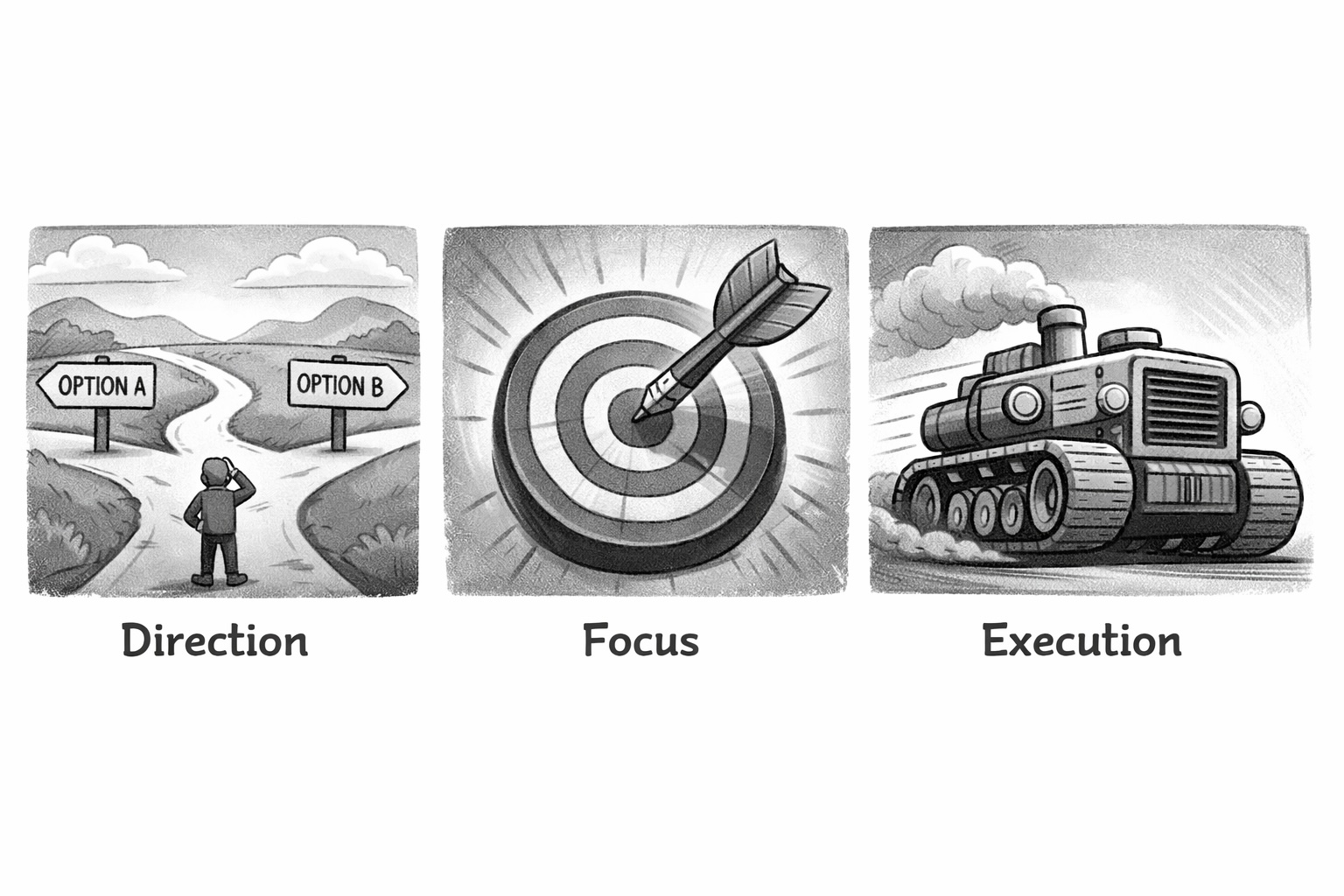
The Discipline of Direction
Why focus beats feature bloat in the AI era
In a world where AI lets a single founder build what once required an entire engineering team, the real competition isn’t about how much you can create—it’s about what you choose to create.
The AI Paradox: Unlimited tools, limited guidance
AI has slashed the cost of software development to a point that seemed impossible a few years ago.
- One‑person teams can now design, prototype, launch, and iterate products that previously needed dozens of engineers.
- Cloud infrastructure is rented by the hour, and large‑language models deliver “cognitive labor” on demand.
- Distribution is global and instantaneous.
All that power creates a new bottleneck: the decision of what to build. The challenge isn’t technical—it’s strategic.
Horizontal vs. vertical startups: two different bets
When you launch an AI‑powered company, you implicitly pick one of two paths.
| Horizontal | Vertical |
|---|---|
| Goal: Build a product that works across many industries. | Goal: Solve the deepest pain points of a single industry. |
| Examples: Slack (workplace communication), Stripe (payments), Notion (general knowledge work). | Examples: Veeva (life‑sciences), Procore (construction), Toast (restaurants). |
| Bet: There’s a shared abstraction underneath industry diversity. | Bet: Industry‑specific complexity (regulation, jargon, legacy processes) is a moat, not noise. |
| Moat: Scale, network effects, minimal customization. | Moat: Depth of expertise, regulatory compliance, switching costs. |
The temptation today is to try both—start narrow then broaden, or launch broad and later specialize. The reality is that each path requires a distinct discipline.
Direction: picking the game you’ll play
Direction isn’t a fluffy mission statement; it’s the game you commit to winning.
- Horizontal direction = “We will abstract the core problem and ship a platform anyone can plug into.”
- Vertical direction = “We will become the indispensable tool for X industry, speaking its language fluently.”
Mixing the two loses the economies of either approach. A horizontal startup that over‑customizes becomes a half‑baked vertical without the deep expertise to command premium pricing. A vertical startup that rushes to generalize dilutes its moat and looks like a feature‑laden commodity.
Focus: the art of refusal
Once direction is set, focus is the enforcement mechanism. It’s not about working harder; it’s about saying no to the right things.
For horizontal startups
- Decline industry‑specific feature requests that fracture the core product.
- Invest in universal primitives—messaging, storage, authentication, workflow orchestration.
- Prioritize distribution, integration, and extensibility over deep niche customization.
For vertical startups
- Dive deep into industry terminology, regulations, and legacy workflows.
- Embed compliance, reporting standards, and domain‑specific analytics into the product.
- Ignore adjacent markets until you’ve cemented credibility and lock‑in in your chosen sector.
Without disciplined focus, the abundance of AI tools makes it easy to chase every “nice‑to‑have” feature, turning direction into drift.
Execution: aligning ops with direction
Execution isn’t generic hustle; it must match the strategic posture you’ve chosen.
| Horizontal execution | Vertical execution |
|---|---|
| Speed, scale, and reliability. Engineering culture prizes performance, uptime, and a great developer experience. | Credibility and embeddedness. Heavy investment in onboarding, customer education, and industry partnerships. |
| Growth leans on network effects, integrations, and API ecosystems. | Roadmap synced to regulatory cycles, sector‑specific events, and deep‑customer feedback loops. |
| AI accelerates feature iteration and UI polish. | AI automates complex, domain‑specific workflows and surfaces sector‑unique insights. |
The tempo of AI changes, but the underlying law stays the same: execution must reinforce direction.
The bigger landscape: layers of the tech stack
Think of today’s technology stack as layers:
- Energy → Computation → Intelligence → Applications
Each layer demands different capital, time horizons, and risk profiles.
- An application company that tries to train foundational models without the requisite resources spreads itself too thin.
- A model‑focused lab that diverts energy into building end‑user features may lose research depth.
Clarity of layer = direction.
Staying within your layer = focus.
Mastering your layer = execution.
Psychological benefits of discipline
When direction is crystal clear, internal debates shrink.
- Teams stop asking “Are we a platform or a tool?” and instead ask, “Does this align with our chosen game?”
- The “refusal” mode becomes instinctive, not a forced checklist.
- Execution becomes a habit rather than a sprint, allowing silent, compounding progress—steady customer retention, deeper integrations, refined workflows.
Key takeaways for founders
- Pick a game: Decide early whether you’re building a horizontal abstraction or a vertical specialty.
- Stay disciplined: Treat focus as a filter—say “no” to anything that pulls you away from your chosen path.
- Match execution to direction: Align engineering speed, growth tactics, and partnership strategies with your strategic bet.
- Know your layer: Don’t try to be a model‑trainer and a consumer‑app at once unless you have the capital to do both.
- Leverage AI wisely: Use it to accelerate what you’re already good at, not to mask strategic drift.
Axon OS: Orchestrate Intelligent Workflows
Direction, Focus, and Execution in the AI Stack
The cost of building software has collapsed. With foundation models, cloud infrastructure, and open tooling, teams can ship complex systems faster than ever. The bottleneck is no longer raw capability — it is architectural clarity.
Every startup must choose its direction deliberately. Are you building a horizontal platform that abstracts common patterns across industries? Or a vertical system deeply embedded in a specific domain? This decision shapes everything: product surface area, pricing, compliance posture, and execution velocity.
Focus is the enforcement layer of strategy. Horizontal systems require aggressive standardization and reusable primitives. Vertical systems demand deep domain modeling, workflow specialization, and regulatory alignment. Blurring these paths introduces architectural drift.
Execution is the runtime engine. It translates direction into compounding systems — through iteration speed, reliability, integration depth, and operational discipline.
We are building an AI‑native orchestration platform designed for this new stack. It enables teams to construct intelligent workflows spanning Data ETL, data science pipelines, and agentic AI systems within a unified execution layer. The platform is secure by design, aligned with enterprise governance requirements, and engineered for horizontal scalability.
In a world where intelligence is programmable, advantage belongs to teams that combine architectural direction, disciplined focus, and execution that scales.
Constant Evolution of AI: Where Do Features and Minor Pivots Fit?
AI evolves at a pace unmatched by previous technology cycles. Models improve monthly. Costs shift. Latency drops. Capabilities expand. New architectural patterns emerge.
In this environment, stagnation is not an option — but neither is instability.
The key distinction is between core direction and adaptive surface evolution.
Core Direction Must Remain Stable
Your core defines:
- The problem you solve
- The layer you operate in (horizontal or vertical)
- Your architectural philosophy
- Your economic model
If these shift frequently, you are not evolving — you are drifting.
Direction should survive:
- Model upgrades
- API changes
- Infrastructure optimizations
If a new model release forces you to rethink your identity, your system lacks structural grounding.
Features Are Surface‑Level Adaptations
Feature evolution is healthy when it:
- Strengthens the core use case
- Improves performance or usability
- Expands capability within existing boundaries
- Leverages new AI improvements modularly
Feature sprawl is unhealthy when it:
- Introduces unrelated workflows
- Fractures the user experience
- Increases governance complexity
- Expands surface area without deepening value
In AI systems, adding a feature is rarely just UI work. It affects:
- Security controls
- Access boundaries
- Resource allocation
- Observability
- Audit trails
Each feature increases systemic responsibility.
Minor Pivots vs Structural Rewrites
A minor pivot refines:
- Target persona
- Workflow optimization
- Pricing strategy
- Model selection
A structural rewrite alters:
- Core architecture
- Layer positioning
- System identity
In fast‑moving AI markets, minor pivots are expected.
Structural rewrites should be rare.
If your architecture is modular — with a stable control plane and swappable intelligence components — you can evolve continuously without destabilizing the system.
Designing for Evolution
The correct posture in AI‑native systems is:
- Stable orchestration layer
- Stable security and governance model
- Modular intelligence adapters
- Observable and testable execution runtime
This allows:
- Model upgrades without workflow rewrites
- Feature expansion without architectural erosion
- Controlled experimentation within safe boundaries
Evolution should occur at the edges, not at the core.
The Principle
In rapidly evolving AI environments:
- Direction anchors you.
- Focus constrains you.
- Modular architecture protects you.
- Controlled iteration advances you.
The goal is not to avoid change.
It is to absorb change without losing structural coherence.
Closing thought
AI has turned the cost of action into near‑zero, but that makes mis‑direction multiply faster. The companies that will thrive aren’t the ones that chase every shiny possibility—they’re the ones that choose a direction, focus relentlessly, and execute with mechanical consistency.
In an age where intelligence is on demand, discipline may be the rarest—and most valuable—advantage of all.
Experiment with AxonOS
If you're building intelligent workflows and want to evolve without architectural instability, consider experimenting with AxonOS — an AI-native orchestration platform that is platform- and cloud-agnostic.
AxonOS enables you to design and run unified workflows spanning Data ETL, data science pipelines, and agentic AI systems within a governed execution layer. Its modular architecture allows you to upgrade models and capabilities without rewriting core orchestration logic.
Built with enterprise-grade security, compliance alignment, and horizontal scalability in mind, AxonOS is engineered to support controlled experimentation without sacrificing structural integrity.
Learn more at: https://www.axonos.ai
Contact us: sales@axonos.ai