Blog

Blog

Recent Posts

Products That Sell: Why Speed, Quality, and AxonOS Build Capabilities Create the Real Winners

· 6 min read
Ravi Kaushik
Founder @ Simtel.AI

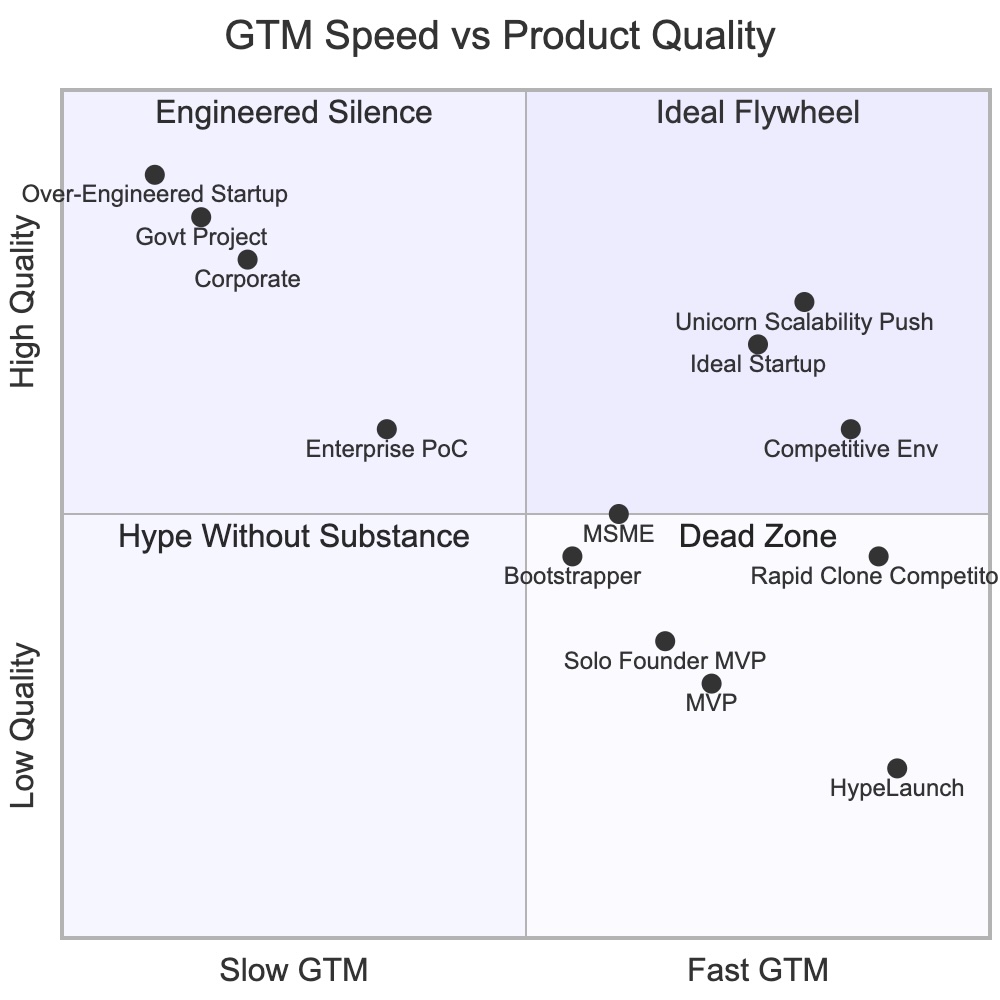
Product Shipping Quadrant

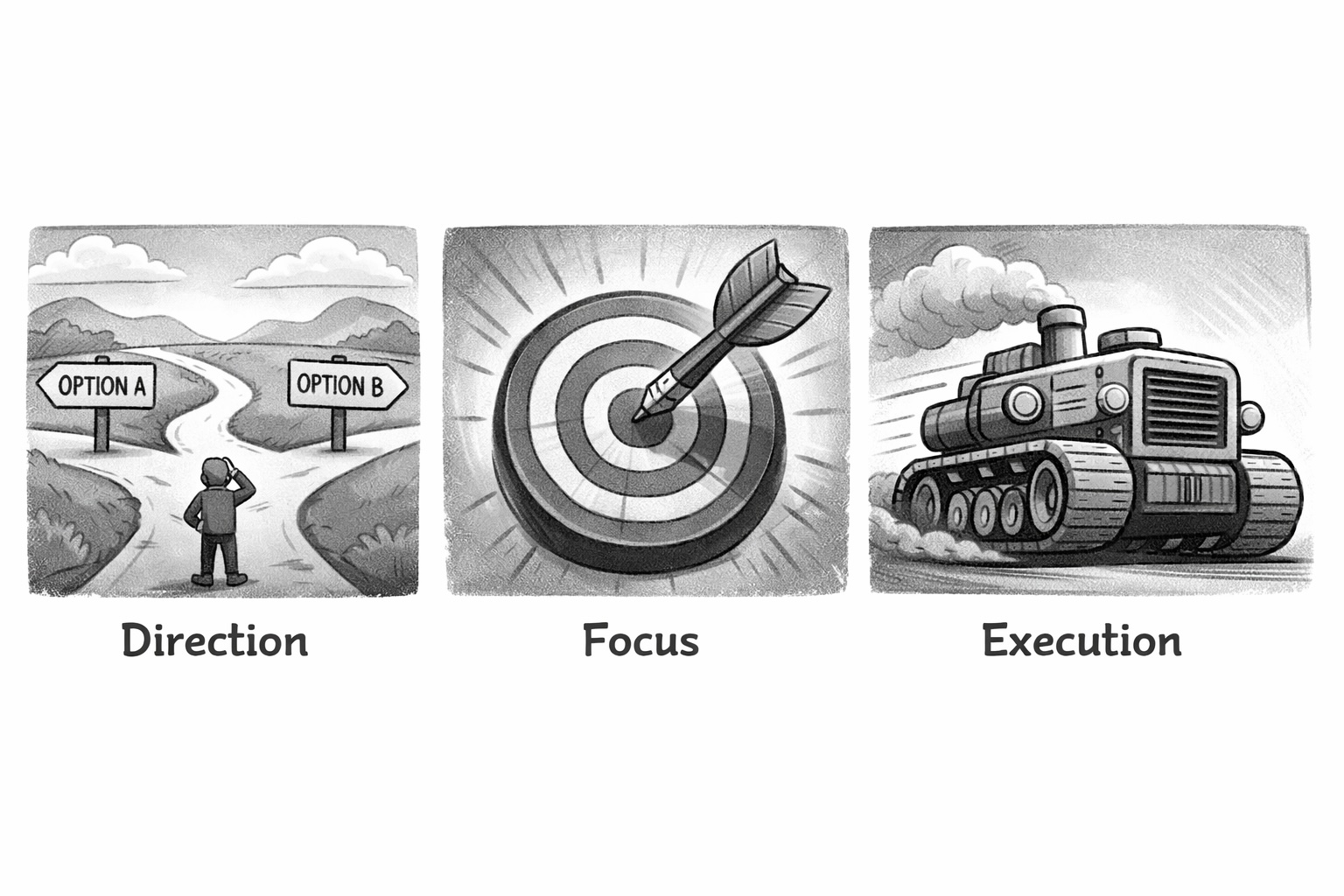
Walk into any startup war room—whiteboards dense with arrows, a half-erased roadmap, coffee rings on the table—and you’ll notice something quietly unsettling: the best ideas don’t always become the best products, and the best products don’t always become the ones that sell.

This isn’t a new discovery.
It’s the same paradox that has shaped every era of technology.
As the New York Times once described of early internet founders, “they weren’t selling software; they were selling the promise that tomorrow could be easier than today.”

Products that sell aren’t built purely on code.
They’re built on momentum, truth, velocity, and timing—and increasingly, on platforms like AxonOS, which let teams build, validate, iterate, and scale faster than the old rules ever allowed.

In this essay we explore what makes a “product that sells,” why most teams fail to reach that zone, and how AxonOS’s build capabilities help founders operate where it matters most: the fast lane of learning and value delivery.


1. Products That Sell Don’t Start Perfect—They Start True

The myth of the “perfect first release” is one of tech’s most persistent illusions.
Founders obsess over architecture.
Teams polish features endlessly.
Everyone waits for the mythical Version 1.0 that will—supposedly—carry the company.

But technology history tells a different story.

One New York Times profile on early consumer startups noted how the breakout successes shared a single trait:
“They understood something uncomfortable, unpolished and real about their users before anyone else did.”

Products that sell begin with:

  • A painful problem
  • A clear emotional trigger
  • A simple way to relieve the pain
  • A fast path to validation

And this is where AxonOS becomes a cheat code.

Instead of writing weeks of infrastructure code, you compose workflows, nodes, and integrations in a matter of hours. You take a raw idea and turn it into something clickable, explorable, demo-able, and most importantly—usable.

Truth becomes the foundation.
Speed becomes the amplifier.


2. PG Was Right (But Misunderstood): “Do Things That Don’t Scale”

Paul Graham’s famous essay echoed something that NYT journalists often admire in early innovators: unreasonable proximity to the customer.

But PG’s advice is almost always misinterpreted.

Most people think it means:

“Move fast. Ship messy. Scale later.”

That’s not what he meant.

What he meant aligns closely with how the Times describes successful early movers:
“They built by hand what others tried to automate too soon.”

PG’s real message:

  • Talk to users directly
  • Hardcode early behaviors
  • Deliver value manually
  • Understand the emotional weight of the problem
  • Then scale the correct system

AxonOS is practically built around this ethos:

  • Build unscalable logic quickly
  • Test workflows on real environments
  • Gather feedback instantly
  • Refine without fear
  • Scale workflows only after correctness is validated

It’s the PG loop—but with power tools.


3. The Quadrant of Winners: Fast GTM × Rising Product Quality

The products that sell live in the upper-right quadrant:

  • Fast GTM: because speed reduces uncertainty
  • High enough quality: because trust is earned, not claimed

The New York Times often frames success not as a binary outcome, but as a balance of tensions:
“The winners were those who managed to move quickly without collapsing under the weight of their own ambition.”

AxonOS makes this balance achievable:

  • Nodes are versioned
  • Workflows evolve without breaking contracts
  • Deployments are instant
  • You ship without DevOps friction
  • You maintain quality with every iteration
  • Rollbacks are painless
  • Observability is built in

You don’t choose between speed and quality.
You operate at the intersection—where products truly sell.


4. The First “Moment of Value” Matters More Than Anything

Every product has a moment—an instant—where the user decides: “This makes my life easier.”

This is the moment the Times once described as “the sliver of clarity where technology stops being novelty and becomes necessity.”

To create this moment, you must deliver:

  • Reduction in friction
  • Reduction in steps
  • Improvement in clarity
  • A feeling of control

And you must deliver it early.

AxonOS accelerates this early win:

  • Build functional prototypes in hours
  • Show users real data flows
  • Personalize node behavior instantly
  • Enable real outcomes, not mockups
  • Turn back-end logic into visual flows
  • Deploy to UAT without overhead

When a user sees a workflow run end-to-end, even if partially manual behind the scenes, the moment of value is immediate and visceral.

That’s when products start to sell.


5. Why Most Teams Fail (And Where AxonOS Helps)

Most teams fail because they:

  • Over-engineer too early
  • Chase edge cases
  • Build internal abstraction layers instead of user value
  • Spend weeks doing DevOps plumbing
  • Ship slowly
  • Iterate even slower

The New York Times frequently highlights how the most innovative teams succeed simply because they “learn faster than the problem changes.”

AxonOS enables that fast learning by removing:

  • Boilerplate development
  • Infrastructure friction
  • Deploy-time uncertainty
  • Integration headaches
  • Versioning conflicts
  • Rollback risk
  • Environment inconsistency

You’re not slowed down by the machinery of software.
You’re focused on discovering what matters.


6. The Anatomy of a Product That Sells (Checklist)

A. Solve a painful problem

If it doesn’t hurt, it doesn’t sell.

B. Deliver relief early

Your first 10 minutes matter more than your next 10 features.

C. Build as if observing a human story

NYT-style thinking:
What’s the narrative arc of your user’s day?
Where is the conflict, tension, release?

D. Reduce cognitive load

People buy simplicity, not complexity.

E. Iterate weekly

Monthly iteration is death.

F. Build trust through reliability

Quality is reputation.

G. Use a learning engine

This is where AxonOS shines.
It gives you the mechanics to:

  • Learn in production
  • Correct quickly
  • Deploy safely
  • Scale wisely

Products that sell do not stagnate.
They compound.


7. Conclusion: The Future Belongs to the Fast Learners

The best description of breakout products came from a NYT profile of early internet pioneers:
“They didn’t predict the future. They built it, tested it, rewrote it, and rebuilt it again—until reality bent to their persistence.”

Products that sell are built the same way:

  • Fast
  • Truth-first
  • User-centered
  • Reliable
  • Iterative
  • Scalable only when needed

And tools like AxonOS make this process not only possible but predictable.

When you combine:

  • A painful problem
  • A fast feedback loop
  • High-enough product quality
  • A scalable build system like AxonOS
  • And the willingness to do things that don’t scale

You move into the rare territory where products begin selling even when you’re not in the room.

That’s the dream every founder is chasing.
That’s the power of building in the upper-right quadrant.
And that’s the promise of AxonOS.

What This Means for the Industry

We see this as a major step toward AI-native orchestration platforms. By aligning human-readable definitions with machine-executable workflows, we reduce friction, improve collaboration, and unlock entirely new possibilities for autonomous applications.

At Simtel.ai, we’re not just building tools — we’re building the language of the future for humans and machines to co-create software.

if you are interested, do checkout https://www.axonos.ai and use the free account to test your ideas!

Creative Destruction: How Innovation Evolves with This Nobel Winning Idea

· 7 min read
Ravi Kaushik
Founder @ Simtel.AI

Creative Destruction

What is creative destruction?

Creative destruction is an economic concept describing the process through which new innovations replace outdated technologies, products or business models.
The term explains how progress often requires dismantling existing structures to make space for more efficient and productive ones.
As new ideas emerge, they disrupt incumbents, reallocate resources and reshape industries.
Though disruptive in the short term, this cycle is essential for long-term economic growth and rising living standards.
Creative destruction highlights that innovation is both constructive and destabilizing, forming the core mechanism of sustained economic development.

The term creative destruction was originally coined by the German economist Werner Sombart.
It was later popularized and given its modern economic meaning by Joseph Schumpeter in his 1942 work Capitalism, Socialism and Democracy.

The 2025 Sveriges Riksbank Prize in Economic Sciences in Memory of Alfred Nobel was awarded to Joel Mokyr, Philippe Aghion and Peter Howitt “for having explained innovation-driven economic growth”. oai_citation:0‡NobelPrize.org

  • Joel Mokyr was recognized “for having identified the prerequisites for sustained growth through technological progress.” oai_citation:1‡NobelPrize.org
  • Philippe Aghion and Peter Howitt were awarded “for the theory of sustained growth through creative destruction.” oai_citation:2‡NobelPrize.org
    Their collective work shows that economic growth is not automatic: it depends on innovation, competition, and the replacement of outdated systems. oai_citation:3‡reuters.com

AI Innovation

AxonOS embodies the principle of creative destruction—the idea that progress emerges not from preserving the old, but from continually replacing it with something better. Rooted in the Nobel-recognized economic theory, this philosophy shapes how AxonOS is designed, built, and evolved. Rather than accumulating technical debt over time, the platform is architected to adapt, improve, and reinvent itself with each iteration.

At its core, AxonOS treats workflows, nodes, and automations as modular, versioned entities. Each unit can be upgraded, deprecated, or replaced independently—without disrupting the overall system. This modular design ensures that innovation can happen continuously and safely. New layers—such as AI-native nodes, agentic workflows, and real-time orchestration—are introduced to supersede older constructs, while legacy components are phased out once superior alternatives emerge.

This deliberate cycle of renewal ensures that AxonOS keeps advancing in performance, reliability, and developer experience. By fostering internal competition of ideas, the platform encourages multiple approaches to the same problem, promoting only the best-performing ones. This built-in Darwinism keeps the architecture agile and prevents stagnation, freeing engineering teams from maintaining outdated or inefficient code.

In practice, AxonOS enables users to build and evolve AI-powered workflows at an unprecedented pace. Its modular nodes can be assembled to create automations, intelligent agents, or data pipelines. Developers can prototype rapidly, compare competing designs, and retain only the versions that deliver optimal results. Through built-in versioning, workflows evolve naturally—improving without losing their historical context.

AxonOS’s AI-native components further streamline integration with models, embeddings, decision logic, and external actions. Because each module is swappable, users can upgrade or replace specific parts of a system without rewriting entire workflows. This flexibility encourages experimentation: new variants can be tested, measured, and adopted quickly based on data-driven performance insights.

Behind the scenes, AxonOS abstracts away the operational overhead of deployment, scaling, and orchestration, allowing users to focus entirely on creative problem-solving. Integrated monitoring and analytics tools help identify bottlenecks and continuously refine automations.

In essence, AxonOS transforms the theory of creative destruction into an operational reality. It turns innovation into an ongoing cycle—where every idea can be created, tested, improved, and replaced. By doing so, AxonOS not only evolves as a platform but also empowers its users to evolve alongside it—building systems that are as dynamic and adaptable as the ideas that power them.

Creative destruction guides AxonOS by shaping both how the platform is built and how users innovate on it.

As a principle, it emphasizes that progress comes from replacing outdated systems with superior ones. AxonOS adopts this by designing every component—nodes, workflows, models and integrations—to be modular, swappable and upgradable. Old implementations are not preserved indefinitely; they are intentionally retired when better solutions emerge. This keeps the platform lean, adaptable and focused on continuous improvement. For users, AxonOS becomes a tool for innovation because it enables rapid experimentation. Multiple workflow versions can be created, compared and iterated without fear of breaking the system. Underperforming ideas can be discarded, and stronger ones take their place—mirroring the cycle of creative destruction. As a result, AxonOS supports a dynamic environment where innovation is not a one-time event but an ongoing process. It empowers users to build, test, refine and evolve ideas quickly, turning creative destruction into a practical engine for innovation.

Axon OS Workflow Execution Engine

A vivid example of creative destruction within AxonOS comes from the evolution of its workflow execution engine—shaped through a series of deliberate experiments and architectural competitions. Rather than committing early to a single design, the AxonOS team explored multiple parallel approaches, each representing a different philosophy of orchestration and performance.

One prototype used a pub/sub model, where every node emitted events into a lightweight broker. This approach offered highly decoupled execution and fine-grained scalability. In parallel, an event-driven executor was developed to trigger node execution purely based on state transitions, minimizing orchestration overhead and improving responsiveness.

To evaluate runtime efficiency and isolation, AxonOS engineers compared in-memory execution, prized for its speed but limited in isolation guarantees, against a containerized model that offered stronger sandboxing at the cost of startup latency. For data transfer between nodes, the team tested two paradigms: low-latency in-memory transfers (similar to XCom) for lightweight pipelines, and disk-based handoffs for large payloads or cross-container communication.

Each approach was rigorously benchmarked across real-world workloads—spanning branching graphs, multi-model orchestration, and large embedding transfers. The outcome revealed that no single model excelled universally. Instead, a hybrid architecture emerged as the optimal solution: • Event-driven triggers for adaptive orchestration • In-memory transfers for small artifacts • Disk-backed spillover for large datasets • Containerized isolation for untrusted or resource-intensive nodes

This hybrid executor combined the best of all experiments, replacing the earlier monolithic system with a modular, high-performance architecture. The process exemplified AxonOS’s philosophy of creative destruction: systematically testing, comparing, and replacing inferior designs with superior ones. Through this disciplined cycle of experimentation and renewal, AxonOS continuously strengthens its foundation while maintaining the agility to evolve with future demands.

What This Means for the Industry

We see this as a major step toward AI-native orchestration platforms. By aligning human-readable definitions with machine-executable workflows, we reduce friction, improve collaboration, and unlock entirely new possibilities for autonomous applications.

At Simtel.ai, we’re not just building tools — we’re building the language of the future for humans and machines to co-create software.

if you are interested, do checkout https://www.axonos.ai and use the free account to test your ideas!

The 4Ps of Marketing in the Age of AI

· 7 min read
Ravi Kaushik
Founder @ Simtel.AI

For decades, business schools and boardrooms alike have leaned on the timeless 4Ps of marketing—Product, Price, Place, and Promotion—as the foundation for strategy. Yet as artificial intelligence reshapes industries, automates decision-making, and redefines competition, these four pillars are shifting in profound ways. In the AI era, what once felt like stable ground is suddenly fluid, adaptive, and in constant motion.

Product: From Features to Personalization and Speed

In the traditional sense, a product was a bundle of features, a differentiated design, or an experience that stood apart from competitors. But AI changes this dynamic. In a world where algorithms can replicate functionality overnight, product differentiation through features becomes fragile. What matters more is not what you ship but how quickly and intelligently you evolve.

Products in the AI era are not static objects; they are living systems. They continuously learn from customer behavior, adapt in real time, and personalize experiences down to the individual level. Two companies may offer nearly identical features, but the one that uses AI to fine-tune recommendations, anticipate needs, and build trust through reliability wins. Speed of iteration, personalization depth, and the trust customers place in your system become the true differentiators.

Price: From Fixed to Fluid and Adaptive

Pricing, once a carefully planned exercise, is now a dynamic and context-driven game. AI enables businesses to move away from fixed tags and toward adaptive, algorithmic pricing models. No longer do all customers face the same price; instead, prices may fluctuate based on demand, individual willingness to pay, or even churn risk.

Just as Uber normalized surge pricing, the broader economy is moving toward AI-driven adjustments that are invisible yet constant. Subscription tiers, pay-per-use models, and micro-segmentation experiments are tested at scale, often in real time. In this new environment, price becomes less of a static decision and more of a living conversation between business and customer, mediated by AI.

Place: From Distribution Channels to Algorithmic Visibility

Traditionally, “place” referred to distribution: the shelves your product sat on, the stores you sold through, or the digital marketplaces you occupied. In the AI world, place is about visibility inside algorithmic ecosystems.

Recommendation engines, search rankings, voice assistants, and AI agents are the new retail shelves. Being present in the right place no longer means securing physical shelf space, but instead ensuring your product or service is discoverable when AI intermediaries are guiding consumer attention. For B2B businesses, AI systems can identify hidden micro-markets, automate outreach, and even negotiate deals. In other words, place becomes algorithmically optimized omnipresence.

Promotion: From Campaigns to Contextual Conversations

Promotion has always been about telling your story and persuading your audience. But in the AI-driven era, the very nature of communication changes. Instead of mass campaigns and broad messaging, businesses now rely on hyper-personalized, context-aware interactions.

AI allows companies to run thousands of creative experiments simultaneously, tailoring tone, message, and channel for each micro-segment of customers. Promotion becomes less about broadcasting and more about dialoguing—meeting the customer where they are, with content that resonates at the exact moment of need. While AI handles the scale and personalization, human marketers still matter deeply: trust, empathy, and authenticity remain irreplaceable.


AI-as-a-service

Software-as-a-Service (SaaS) defined the last two decades of enterprise technology. But in the age of artificial intelligence, SaaS feels increasingly outdated. What matters now is AI-as-a-Service (AIaaS)—platforms that deliver intelligence, not just software, through APIs, agents, and adaptive workflows. Marketing in this new landscape does not follow the same rules as SaaS; instead, it is being reshaped at every level by AI itself. Let’s examine how the classic 4Ps—Product, Price, Place, and Promotion—transform in the AIaaS world.

Product: Intelligence That Evolves in Real Time

In AIaaS, the product is not a static bundle of code or features. It is a living system of models, data, and adaptive capabilities. Competitors can replicate surface-level functionality quickly, but what cannot be cloned is the depth of personalization, the proprietary data pipelines, and the speed of iteration.

Here, differentiation comes from three key dimensions:

  1. Personalization – AIaaS must shape its responses, recommendations, or workflows uniquely for each user or enterprise.
  2. Data moats – proprietary datasets and fine-tuned models that create defensibility.
  3. Trust and governance – customers will choose providers that are transparent about bias, reliability, and security.

The product in AIaaS is not merely “software delivered via the cloud.” It is intelligence delivered continuously, with trust and adaptability as the defining features.

Price: Dynamic, Usage-Based, and Value-Linked

Pricing in AIaaS cannot remain fixed or static. Instead, it naturally evolves toward dynamic, usage-based models that scale with consumption. Whether it is per API call, per token, or per agent-run, customers expect to pay in proportion to value delivered.

AI makes this even more fluid. Providers can adjust prices in real time based on:

  • Workload intensity (e.g., higher rates for GPU-heavy jobs).
  • Customer value (outcome-based pricing, tied to business KPIs).
  • Retention risk (AI dynamically offering discounts to prevent churn).

This means no two customers may pay the same rate. Pricing engines continuously optimize, just like ad auctions. For AIaaS, price becomes a conversation mediated by algorithms, where fairness and perceived value matter as much as revenue optimization.

Place: Distribution Through AI Ecosystems

In the AIaaS world, “place” is not about shelves, storefronts, or even just marketplace listings. It is about meeting people where they actively explore, learn, and form opinions about AI.

Discovery for AIaaS happens in social outlets—LinkedIn threads, X/Twitter debates, Discord and Slack communities, YouTube explainers, Substack essays, and niche AI newsletters. These platforms have become the modern “storefronts,” where people test ideas, seek recommendations, and validate credibility before engaging with a product.

Distribution is no longer only about embedding inside ecosystems; it is about being present in the conversations where trust and authority are built. Word-of-mouth has shifted into digital-first thought leadership, where every post, demo video, or open-source contribution becomes a channel for discovery.

For AIaaS providers, this means the strategy is two-fold:

  1. Be visible in social outlets where communities gather to learn and evaluate AI tools.
  2. Enable self-serve exploration with freemium trials, open APIs, and sandbox environments that lower the barrier to adoption.

In short, place in the AIaaS era is less about traditional distribution and more about social discoverability and community-driven validation.

Promotion: Intelligent Conversations Over Static Campaigns

Traditional SaaS relied on content marketing, webinars, and automated funnels. AIaaS goes further—promotion becomes contextual, conversational, and AI-powered itself.

  • AI can generate personalized messaging for every prospect, adapting tone and value proposition dynamically.
  • Real-time experimentation allows thousands of ad variations to run simultaneously, each tuned to micro-segments.
  • Conversational agents handle the majority of the sales cycle—educating, demoing, and even negotiating—before handing off to humans for trust-based closures.

Promotion in AIaaS is not about broadcasting campaigns; it is about orchestrating ongoing, intelligent, trust-driven dialogues with customers at scale.


The Future of Marketing in AI-as-a-Service

The AIaaS era does not kill the 4Ps—it redefines them:

  • Product becomes adaptive intelligence, fueled by personalization, data moats, and trust.
  • Price becomes dynamic, usage-based, and tied to outcomes.
  • Place becomes distribution through AI ecosystems and intermediaries.
  • Promotion becomes intelligent, personalized conversations rather than one-way campaigns.

AIaaS is not just “SaaS with smarter features.” It is a new category where marketing, like the product itself, must be adaptive, intelligent, and continuous. Companies that understand this shift will not just market AI services—they will market with AI, through AI, and for AI.

In short, the 4Ps in the AI world are not disappearing—they are transforming. Product becomes about personalization and speed. Price becomes adaptive and algorithmic. Place becomes about algorithmic visibility. Promotion evolves into contextual, conversational marketing. Businesses that recognize and act on these shifts will find themselves not just surviving in the AI age, but shaping it.

A Patent on AxonOS AI-Native platform, where you can orchestrate intelligent workflows

· 3 min read
Ravi Kaushik
Founder @ Simtel.AI

Application Filed: A SYSTEM AND METHOD FOR AI-ASSISTED APPLICATION DEVELOPMENT PLATFORM USING A DEFINITION LANGUAGE

At Simtel.AI, we believe the next generation of software will be built not just by humans, but in collaboration with intelligent systems. Our latest invention — an AI-assisted application development platform using a definition language (DL) — addresses long-standing challenges in software engineering, making development faster, more secure, and more scalable.

Why We Built This

Traditional software development relies on hand-written source code, framework-specific tools, and disconnected orchestration systems. Even with low-code and no-code platforms, developers struggle with:

  • Fragmentation: Visual design tools, source code, and execution logic are often out of sync.
  • Scalability gaps: Current platforms lack persistent AI agent memory, dynamic orchestration, and robust credential management.
  • Limited AI integration: AI is usually bolted on, not embedded as a core design principle.

The result? Redundant work, brittle workflows, and difficulty scaling AI-native applications.

Our Approach: Definition Language (DL)

We introduce a JSON-based definition language that acts as a single source of truth. It’s readable by humans, executable by machines, and editable by AI models. This unified specification brings together inputs, outputs, credentials, execution logic, source code, and UI — eliminating silos.

Key capabilities include:

  1. Executable JSON Node Templates – Standardized building blocks for workflows, validated with AI guardrails.
  2. Bi-directional Visual & Code Sync – Graphical workflows always stay aligned with JSON specifications.
  3. Secure Credential Resolution – Zero-knowledge architecture ensures secrets are never exposed.
  4. AI-Driven Workflow Generation – Large language models can generate, debug, and refactor workflows in real-time.
  5. Scalable Deployment – Workflows become containerized microservices or API endpoints ready for cloud, edge, or on-prem.

Inside the Platform

Our system brings together several powerful modules:

  • AI Agentic Module: Defines capabilities in DL-based JSON.
  • Node Builder & Explorer: Lets developers and AI co-create functional units.
  • Flow AI Workspace: Translates high-level goals into DAG-based workflows.
  • Orchestration & Deployment Engine: Converts workflows into containerized applications with monitoring, testing, and governance built-in.

By combining these, developers, startups, and enterprises can build applications with greater speed, reliability, and compliance.

Benefits for the Future of AI-Native Software

  • Faster Iteration: Visual and AI-assisted tools reduce development cycles.
  • Stronger Security: Credential vaulting and schema validation enforce safety by design.
  • True AI-Native: Agents retain memory, execute complex orchestration, and self-improve over time.
  • Enterprise-Ready: Compliance, governance, and certification are embedded into the workflow.

What This Means for the Industry

We see this as a major step toward AI-native orchestration platforms. By aligning human-readable definitions with machine-executable workflows, we reduce friction, improve collaboration, and unlock entirely new possibilities for autonomous applications.

At Simtel.ai, we’re not just building tools — we’re building the language of the future for humans and machines to co-create software.

Introducing AxonOS: The 7 Layers of Intelligence

· 6 min read
Ravi Kaushik
Founder @ Simtel.AI

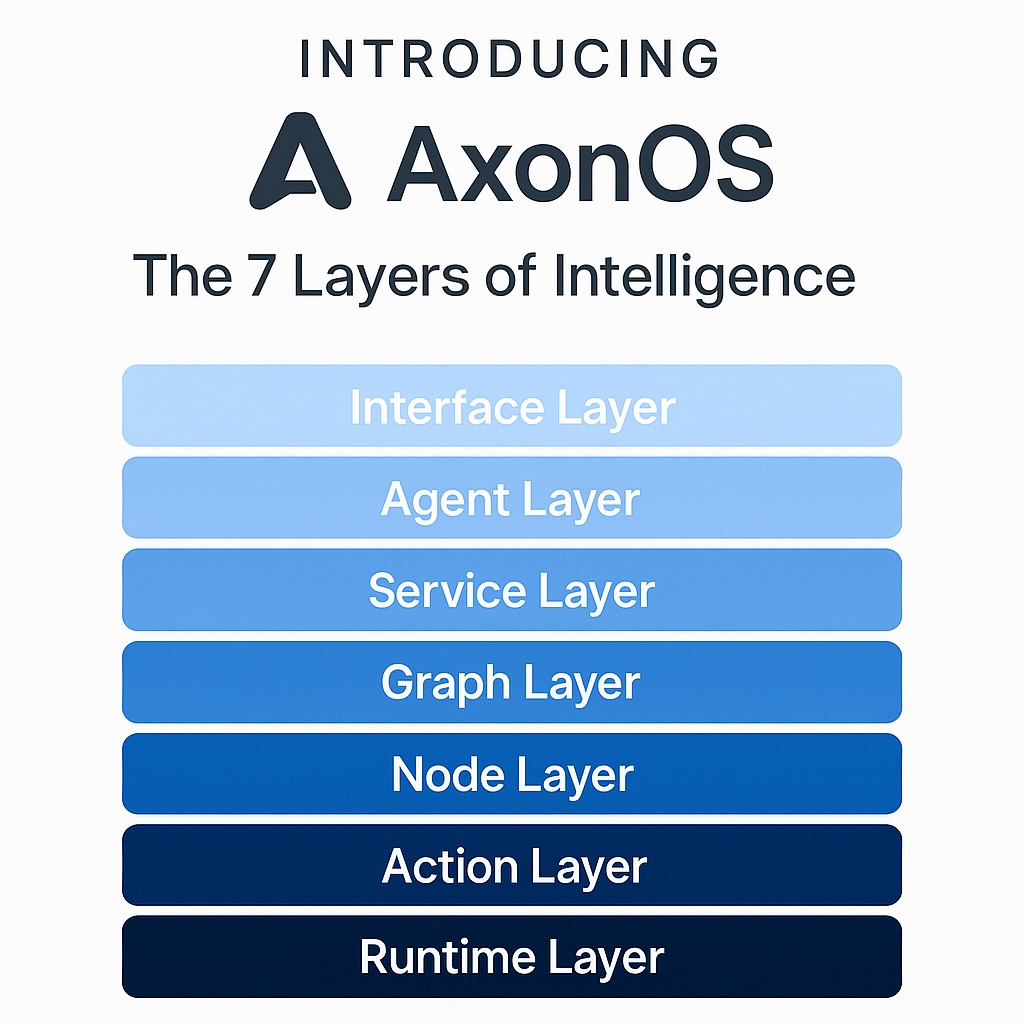
AxonOS Architecture

At Simtel.AI, we believe the future of software isn't just about automation—it's about intelligence that adapts, composes, and evolves.

That's why we're building AxonOS, a modular operating system for orchestrating intelligence. Not just another workflow engine or LLM wrapper, AxonOS introduces a powerful layered design that brings human intention, AI reasoning, and executable logic into a single, unified framework.

Why Layers?

Modern software is bloated. It entangles data, execution, AI, and user interfaces into rigid stacks that don't scale with complexity or abstraction. We reimagined this—from the bottom up.

AxonOS is designed as a 7-layer stack, where each layer plays a distinct role in building, operating, and evolving intelligent systems.

Without going into proprietary details, here's a high-level look:

1. Action Layer – The Foundation of Execution

The raw execution units. These are the smallest, testable, sandboxed functions that do real work.

  • Atomic Operations: Each action performs a single, well-defined task
  • Sandboxed Execution: Isolated runtime environments prevent interference
  • Composable by Design: Actions can be combined into more complex operations

2. Node Layer – Building Blocks of Logic

Composable logic blocks. Nodes define clear inputs, outputs, and configuration—executable across runtimes.

  • Type-Safe Interfaces: Clearly defined input/output contracts
  • Runtime Agnostic: Execute in containers, serverless, or local environments
  • Configuration Driven: Parameterizable behavior without code changes

3. Graph Layer – The Flow of Intelligence

The flow of logic and data. Graphs (or "Nets") connect nodes based on dependency, data flow, and control structure.

  • Dependency Management: Automatic resolution of execution order
  • Data Flow Optimization: Efficient routing of information between nodes
  • Control Structures: Support for conditionals, loops, and parallel execution

4. Service Layer – Deployment and Exposure

Microservices that can expose graphs, nodes, or actions via APIs or schedules. Deployable anywhere.

  • API Generation: Automatic REST/GraphQL endpoint creation
  • Scheduling Support: Cron-like execution for batch operations
  • Multi-Protocol: HTTP, gRPC, WebSocket, and message queue interfaces

5. Agent Layer – Autonomous Decision Making

The decision-making layer. Where goals, memory, and tool selection begin to act autonomously.

  • Goal-Oriented Behavior: High-level objective decomposition
  • Memory Systems: Context retention across interactions
  • Tool Selection: Dynamic choice of appropriate actions and nodes

6. Interface Layer – Human-AI Interaction

Where humans meet the system. Think of it as the agent's skin: UI components, prompts, APIs, chats.

  • Multi-Modal Interfaces: Text, voice, visual, and programmatic access
  • Dynamic UI Generation: Context-aware interface adaptation
  • Prompt Engineering: Integrated natural language processing

7. Runtime Layer – Orchestration Engine (Optional)

A pluggable orchestration engine that powers execution, tracing, scaling, and caching.

  • Execution Orchestration: Distributed processing coordination
  • Observability: Real-time monitoring and debugging
  • Auto-Scaling: Dynamic resource allocation based on demand

Built for the New Stack

AxonOS isn't built for static codebases or cloud vendor lock-in. It's built for:

  • Tool Use + Reasoning: Seamless integration of AI decision-making with tool execution
  • Visual + Prompt-Based Programming: Both graphical interfaces and natural language programming
  • Rapid API + Container Deployment: One-click deployment to any infrastructure
  • Observability Across Logic + AI Decisions: Full traceability from user intent to execution
  • Open Integration with OSS Tools: Compatible with existing open-source ecosystems

What Can You Do With It?

Build Composable AI Systems

Create intelligent systems that span code, tools, APIs, and agents without vendor lock-in or rigid frameworks.

Deploy Intelligence Modules

Package and deploy reusable "Intelligence Modules" anywhere: API endpoints, scheduled jobs, containers, or distributed node networks.

Mix Declarative and Imperative Logic

Combine structured programming with fuzzy AI reasoning—let the system choose the best approach for each task.

Host Your Own AI Runtimes

Maintain full control over your AI infrastructure with built-in governance, explainability, and observability.

The Architecture Advantage

Traditional software architectures force you to choose between:

  • Rigid Structure vs Flexible Intelligence
  • Deterministic Behavior vs Adaptive Learning
  • Human Control vs AI Autonomy

AxonOS eliminates these false choices. Each layer provides specific capabilities while maintaining clean interfaces with adjacent layers. This allows for:

  • Gradual Intelligence: Start with simple automation, evolve to full autonomy
  • Selective AI: Apply AI reasoning only where it adds value
  • Human Override: Maintain control while leveraging AI capabilities

Use Cases and Applications

Enterprise Automation

  • Intelligent Document Processing: Extract, validate, and route documents with AI-powered decision making
  • Customer Service Orchestration: Combine rule-based routing with AI-powered response generation
  • Supply Chain Optimization: Dynamic planning that adapts to real-time conditions

Development and DevOps

  • Intelligent CI/CD Pipelines: Self-optimizing deployment workflows
  • Automated Code Review: AI-assisted quality assurance with human oversight
  • Infrastructure Management: Adaptive scaling and self-healing systems

Data and Analytics

  • Automated Data Pipelines: Self-configuring ETL processes
  • Intelligent Monitoring: Proactive alerting with contextual recommendations
  • Dynamic Reporting: AI-generated insights with human validation

Coming Soon

We'll be opening up early access to the AxonOS sandbox and our open protocol (ADL) for describing intelligent systems.

What to Expect:

  • Interactive Sandbox: Experiment with AxonOS layers in a browser-based environment
  • ADL Protocol: Open specification for describing intelligent system architectures
  • Community Tools: Open-source components and integrations
  • Developer Resources: Comprehensive documentation, tutorials, and examples

Join the Beta

Ready to experience the future of intelligent systems? Register for early beta access and be among the first to build with AxonOS.

Beta participants will get:

  • Priority Access: First to try new features and capabilities
  • Direct Feedback Channel: Shape the development with your insights
  • Exclusive Resources: Advanced tutorials and use case examples
  • Community Access: Connect with other beta developers

Until then, follow us as we unfold how agents, logic, and interfaces are merging into the next fabric of computing.

Get Involved

Website: https://axonos.ai
Sandbox: https://sandbox.axonos.ai (coming soon)
Twitter/X: @SimtelAI
Documentation: https://docs.axonos.ai (coming soon)
Simtel.AI: https://simtel.ai


Intelligence isn't a feature. It's a structure. And it's time to build it right.

The future of software is intelligent, modular, and human-centric. AxonOS is designed to make that future accessible to every developer, every organization, and every human working with AI.

Join us at Simtel.AI in building the operating system for the age of intelligence.

Agentic AI: Navigating the Critical Issues and Transformative Opportunities

· 8 min read
Ravi Kaushik
Founder @ Simtel.AI

By Ravi Kaushik, Founder – Simtel.ai
📅 July 3, 2025
📍 Bangalore, India


Bangalore, July 2025 — A recently discovered flaw in Microsoft’s Copilot revealed that data from private GitHub repositories—once briefly public—remained accessible via cached AI responses. This echoes growing concerns in developer communities: AI-generated code may look correct, but fail quietly and dangerously in production.

Behind the excitement surrounding GitHub Copilot, Claude, and autonomous code agents lies a less-discussed truth: agentic AI coding is still in its infancy—brilliant in demos, brittle in deployment.


The Story of the Forgotten Code Block

Once upon a sprint, a small team of developers quickly scaffolded an automation flow using their favorite low-code tool. The first version was beautiful—clean modules, well-labeled nodes, and documentation inline.

But as product requirements shifted, more logic was wedged into the same workflow. A quick fix here, a duplicated condition there. By the third sprint, functions had been pasted multiple times with slight variations. Each new teammate added their own flavor—some used callbacks, others async/await. API tokens were hardcoded in one block, loaded from .env in another.

Soon, the original logic was buried under layers of "temporary" patches. Modules had overlapping responsibilities. Naming conventions diverged. No one dared touch the oldest nodes, afraid they'd collapse the fragile domino tower.

At one point, a junior developer cloned a workflow to create a variant—but forgot to update all endpoints. Two inconsistent versions were now in production. Bugs surfaced. Nobody could tell which version was correct, or which block still mattered.

Eventually, the team paused all feature work for a full sprint just to "clean up the mess."

The moral?
Code rot is real—even in visual or modular systems. Without structure, governance, and visibility, your "quick wins" become technical debt. Reusable, composable architecture matters—not just the first time you build, but every time you iterate.

When Agentic Coding Becomes Expensive Technical Debt

It started with a small task—"Just ask Claude to generate a webhook handler." The response was instant, and the developer pasted it straight into the project. A quick test, it worked. Everyone was impressed.

But soon, every feature was delegated to the AI.

Need a cron job? Ask Claude.
Want an auth middleware? Ask Claude.
Need an integration with a third-party API? Ask Claude again.

Each time, the code was slightly different. Sometimes verbose, sometimes abstract. Functions were duplicated across files. Similar logic was rewritten with different libraries. The team stopped reasoning about the code and simply became assemblers of AI-generated snippets.

Weeks passed.

Merge conflicts became harder. Refactors broke things silently. No one knew which function was the source of truth. Claude had generated hundreds of lines of boilerplate—but the software felt heavier, slower, and more brittle.

Performance issues crept in. Devs spent hours hunting bugs that originated from AI-hallucinated logic. Dependencies bloated. Even small modules took seconds to load. Memory usage doubled. CI pipelines slowed to a crawl.

When a security audit was required, the team realized they didn’t understand half the codebase. “Who wrote this?” became a running joke.

Eventually, the CTO made the hard call:

“We need to pause new development. This is unmaintainable.”

It took a month to clean up—removing redundant modules, consolidating logic, rewriting parts from scratch. The cost was real:

  • Lost developer trust
  • Delayed roadmap
  • Mounting cloud costs
  • And hundreds of hours sunk into cleanup

1. Security & Reliability Problems in AI Code

Recent research reveals serious vulnerabilities in AI-generated code:

  • An empirical study found 29.5% of Copilot’s Python and 24.2% of JavaScript snippets contained high-risk security issues across 43 CWE categories.
  • Follow-up studies show 27% of Copilot-generated code is still insecure, only marginally improved over earlier versions.
  • A 2021 audit observed that 40% of Copilot’s suggestions contained exploitable flaws, especially when dealing with cryptography, APIs, or auth logic.

2. Context & Memory Are Still Bottlenecks

Despite improving model sizes, LLMs remain fragile at software architecture. They:

  • Lose context across files
  • Hallucinate module structure
  • Struggle with evolving state or long-lived design threads

3. Hallucination & Lack of Explainability

Even if code compiles, agentic AI lacks reasoning or traceability. Developers report:

  • Code that silently fails logical tests
  • Missing edge cases
  • No clarity on why the AI made a specific decision

4. Human Developers Pull Back

Despite popularity, developers reject over 70% of AI-generated code. Key reasons include:

  • Lack of trust
  • Need for constant verification
  • Fear of subtle vulnerabilities or regressions

5. Poisoning & Provenance Risks

Most agentic AI tools train on open codebases—some of which are poisoned intentionally with insecure patterns. Without audit trails or module lineage, this creates:

  • Propagation of unsafe logic
  • Loss of trust in AI-written infrastructure
  • Zero accountability in collaborative enterprise settings

How Agentic AI Tries to Solve These Gaps

Agentic AI papers propose integrating planning and execution capabilities through a structured, iterative architecture that enables autonomous, goal-driven behavior. The core approaches and mechanisms highlighted across recent research include:

1. Sense-Plan-Act Cycle

  • Agentic AI systems operate on a sense-plan-act cycle: they perceive their environment, formulate a plan based on goals and context, and then execute tasks autonomously. This cycle is foundational, allowing agents to interpret data, plan actions, and adapt execution as conditions change [1][2][3].

2. Task Decomposition and Planning

  • Upon receiving a goal, the agent breaks down complex objectives into smaller, manageable subtasks. This decomposition is guided by advanced reasoning—using heuristics, search algorithms, or neural networks—to map out the optimal sequence of actions [4][2][5].
  • Planning frameworks often employ planner-executor architectures, where a planner (often LLM-driven) generates multi-step plans and executor modules carry out each step, leveraging available tools and APIs [2][3].

3. Execution and Feedback Loops

  • Execution is typically sequential and adaptive: the agent performs each subtask, observes outcomes, and adjusts its plan as needed. This feedback loop is crucial for real-time adaptation and error correction [4][5][3].
  • Techniques like ReAct (Reasoning and Acting) and ReWOO (Reasoning Without Observation) alternate between reasoning and action, refining the agent’s approach based on new information [5][3].

4. Memory and Context Handling

  • Agents utilize both short-term and long-term memory systems to track task progress and recall past decisions, enabling coherent multi-step execution and learning from experience [3].

5. Multiagent Collaboration

  • For complex tasks, agentic AI can use multiagent architectures where agents are assigned specific roles (e.g., planner, executor, reviewer) and collaborate via defined protocols. Leader agents may coordinate teams, improving efficiency and adaptability [1].

6. Tool and API Integration

  • Action frameworks are built to interface with external tools (APIs, databases, workflow orchestrators), granting agents the ability to perform real-world operations and automate workflows end-to-end [3].

7. Monitoring and Human Oversight

  • Robust monitoring, logging, and human-in-the-loop mechanisms are integrated to ensure transparency, reliability, and the ability to escalate complex or ambiguous situations to humans [3].

Summary Table: Core Integration Mechanisms

MechanismDescription
Sense-Plan-Act CyclePerceive environment, plan actions, execute, and adapt iteratively
Task DecompositionBreak down goals into actionable subtasks
Planner-Executor PatternLLM-driven planning + tool-based execution
Feedback LoopsContinuous observation, adjustment, and learning
Memory SystemsTrack state and recall past actions/decisions
Multiagent CollaborationSpecialized agents coordinate and execute in parallel
Tool/API IntegrationAgents execute real-world actions via external services
Monitoring & OversightLogging, error handling, and human escalation

By combining these elements, agentic AI systems achieve autonomous, adaptable, and transparent planning and execution, moving beyond reactive automation to deliver robust, goal-oriented solutions in dynamic environments [1–10].


Final Thoughts

We’re at the very beginning of the agentic AI journey. Current tools help, but they:

  • Can’t yet replace the architecture skills of experienced developers
  • Lack safeguards for production-grade deployment
  • Don’t offer provable correctness or auditability

That’s not a flaw—it’s a frontier. A call for researchers, builders, and AI engineers to step in with rigor, openness, and curiosity.

Curious? Simtel.AI is building the next generation of AI software infrastructure in stealth. We’re focused on creating agentic AI systems that are not just powerful, but also safe, explainable, and reliable. If you’re interested in exploring how agentic AI can transform your business, let’s connect at info@simtel.ai


References

  1. https://www.infosys.com/iki/research/agentic-ai-architecture-blueprints.html
  2. https://www.freecodecamp.org/news/the-agentic-ai-handbook/
  3. https://www.matillion.com/blog/what-is-agentic-ai
  4. https://ashling.ai/resources/agentic-ai-its-architecture-decision-making-processes
  5. https://www.saasguru.co/understanding-agentic-ai-planning-patterns/
  6. https://www.uipath.com/ai/agentic-ai
  7. https://www.k2view.com/what-is-agentic-ai/
  8. https://www.oracle.com/artificial-intelligence/agentic-ai/
  9. https://arxiv.org/abs/2412.10999
  10. https://www.pwc.com/m1/en/publications/documents/2024/agentic-ai-the-new-frontier-in-genai-an-executive-playbook.pdf
  11. https://arxiv.org/abs/2310.02059
  12. https://arxiv.org/abs/2108.09293
  13. https://techcrunch.com/2025/02/26/thousands-of-exposed-github-repositories-now-private-can-still-be-accessed-through-copilot
  14. https://www.lasso.security/blog/lasso-major-vulnerability-in-microsoft-copilot
  15. https://www.researchgate.net/publication/384502842_Artificial-Intelligence_Generated_Code_Considered_Harmful_A_Road_Map_for_Secure_and_High-Quality_Code_Generation
  16. https://medium.com/@physimcs/the-limitations-of-ai-generated-code-f2fc635bf12c
  17. https://huggingface.co/papers/2405.06244
  18. https://huggingface.co/collections/open-llms
  19. https://arxiv.org/abs/2308.04451

Building Effective B2C Loyalty Programs: A Complete Guide for Modern Businesses

· 6 min read
Ravi Kaushik
Founder @ Simtel.AI

Building Loyalty That Lasts

In today’s oversaturated digital economy, attention is fleeting, acquisition costs are rising, and consumer expectations have never been higher. For modern B2C brands, customer loyalty is no longer a matter of optional incentives—it’s a cornerstone of sustainable growth.

This shift isn’t theoretical. It’s deeply practical. Studies consistently show that acquiring a new customer can cost five to twenty-five times more than retaining an existing one. Retained customers spend more, refer more, and are far more likely to forgive a mistake. And yet, many businesses still approach loyalty with fragmented, short-term tactics rather than strategic, long-term thinking.

To understand what works today—and what doesn’t—we need to examine how loyalty has evolved and how forward-thinking brands are leveraging technology and design to build loyalty programs that genuinely matter.

The Coupon Conundrum

Most loyalty efforts begin with a coupon. It’s simple, familiar, and immediately effective. A ₹200 discount can nudge a shopper over the checkout line, drive signups, or recover abandoned carts. But over time, coupons—if misused—lose their power. Customers begin to expect them. They delay purchases. Loyalty gives way to opportunism.

But coupons are not inherently flawed. In fact, they are one of the most versatile tools in the retention toolkit—when used strategically.

Consider the difference: a mass-blasted “Flat ₹200 Off” code sent to all users regardless of behavior is a gimmick. It drives transactions, not relationships. On the other hand, a time-sensitive ₹750 coupon offered only after the third successful order of more than ₹5000 is something else entirely. It’s a reward. It’s recognition. And it’s earned.

This is where the line between gimmick and loyalty becomes clear. Coupons can either be part of a pricing race to the bottom or a meaningful step in a larger retention architecture.

Beyond Discounts: The Architecture of Modern Loyalty

A loyalty program today must do more than reward spending. It must reward behavior, engagement, and emotional investment. Here’s how leading B2C businesses are evolving their approach.

  1. Wallet-Based Incentives

Cashback into a virtual wallet (such as Gallyria’s “Neon Wallet”) can be far more powerful than one-time discounts. It gives the customer a reason to return. Instead of depleting margin through repeated offers, businesses give store credit that brings users back into the ecosystem. The key is flexibility: credit can be issued post-return window, after payment is confirmed, or based on user tier.

  1. Milestone-Based Loyalty

Free shipping after five orders. A ₹500 bonus after ten purchases. A premium support tier unlocked after ₹50,000 in lifetime value. These are predictable, structured, and easy to communicate. More importantly, they create a sense of progression—a psychological ladder that customers climb over time.

  1. Tiered Loyalty Programs

Gold, Silver, and Platinum are more than labels—they are behavioral drivers. A customer who is ₹2000 away from unlocking a higher tier with better benefits often accelerates their purchase cycle. Tiered systems work especially well when combined with exclusive perks: early access, higher cashback, or member-only coupons.

  1. Referral and Social Rewards

Referral programs are not new, but their integration into a loyalty engine is. A user who refers five others could receive bonus wallet credit, an exclusive badge, or higher tier status. When paired with personalized acknowledgment (“You’re our top referrer this month”), referrals become a source of pride, not just reward.

  1. Event and Behavior-Triggered Rewards

Loyalty isn’t static. Birthdays, anniversaries, festival seasons, and even user reactivation moments are all touchpoints to surprise and delight. A birthday coupon, a thank-you gift on a one-year membership anniversary, or a free gift on the fifth return can transform transactional customers into brand loyalists.

What Makes a Loyalty Program Work?

It’s not the points, tiers, or tech stack. It’s the clarity, relevance, and execution. • The value proposition must be clear and immediate. • The enrollment and redemption flows must be frictionless. • The rewards must feel personal, timely, and fair. • And the entire experience must be seamlessly integrated across every touchpoint—from website to app to email.

When loyalty programs are designed this way, they do more than retain. They elevate.

Why Most Loyalty Programs Fail

Many loyalty programs fail not because the idea was wrong, but because the execution was misaligned. Overcomplicated point systems, rigid redemption conditions, lack of personalization, and failure to evolve lead to stagnation and eventually, disengagement.

Moreover, loyalty efforts are often siloed from the core product and marketing strategy. This disconnect results in generic rewards that neither surprise nor satisfy.

What’s needed is not another point tracker. What’s needed is a modular, intelligent loyalty system—one that adapts to user behavior, integrates with business rules, and scales with ease.

The Simtel.AI Approach

Simtel.AI was built with this reality in mind. It’s not just a coupon engine. It’s an AI-powered loyalty infrastructure that empowers B2C businesses to build custom, behavior-driven retention systems.

Whether you want to offer instant cashback at checkout or delayed wallet credit after returns clear, Simtel.AI handles it with precision. Whether your goal is to issue milestone-based free shipping or run tiered programs across millions of users, the platform is built to scale.

Using dynamic rules, Simtel.AI enables businesses to configure loyalty logic like: • “Credit ₹300 to wallet after 3 purchases above ₹2000” • “Send a ₹500 coupon on user’s 1-year signup anniversary” • “Apply free shipping after 5 completed orders” • “Only allow tier-2 users to access premium discounts”

All of this is done through APIs and rule interfaces that separate business logic from engineering workflows, ensuring both speed and governance.

With integrated analytics, fraud detection, and personalization capabilities, Simtel.AI becomes the brain behind your loyalty strategy—not just the backend.

The Future of Loyalty

Looking ahead, the most effective loyalty programs won’t rely on brute-force discounts. They will rely on behavioral insight, emotional connection, and seamless digital infrastructure.

As loyalty becomes increasingly data-driven and AI-enhanced, the brands that win will be the ones who see loyalty not as a tactic—but as an ecosystem.

Simtel.AI is here to help you build that ecosystem.

Because in a world of infinite choice, loyalty isn’t found. It’s engineered.

The Future of E-Commerce: Building High-Quality Product Catalogs with AI

· 5 min read
Ravi Kaushik
Founder @ Simtel.AI

Published: June 11, 2025

In the competitive world of online commerce, your product catalog is not just an inventory—it’s your storefront, sales pitch, brand identity, and customer experience all rolled into one. Yet, too often, e-commerce platforms struggle with low-quality listings, inconsistent data, duplicate products, and missing media. These seemingly small problems collectively drain conversion rates, reduce trust, and stifle growth.

Recent advancements in Artificial Intelligence—especially with Large Language Models (LLMs)—are transforming how catalogs are built, maintained, and scaled. Whether you’re a marketplace, D2C brand, aggregator, or B2B wholesaler, the stakes are clear: high-quality product catalogs are no longer optional—they are your edge.

Why Product Catalog Quality Matters

  1. Customer Experience: Inaccurate or sparse listings frustrate users and lead to drop-offs.
  2. Search & Discovery: Poor catalog structure breaks navigation and filters.
  3. Pricing and Promotion Errors: Inconsistent catalog data leads to incorrect pricing, hurting profitability or user trust.
  4. Operational Costs: Manual catalog curation at scale is slow, error-prone, and expensive.

The result? Lost revenue, poor SEO, high return rates, and underutilized inventory.


How AI Delivers High-Quality Catalogs at Scale

1. LLM-Powered Quality Checks

Modern LLMs like GPT-4 and Gemini can perform automated sanity checks on product descriptions, specifications, and even brand tone. These checks can:

  • Flag vague or irrelevant copy.
  • Detect missing key attributes (e.g., dimensions, compatibility).
  • Standardize formatting for specifications (e.g., converting inches to cm).
  • Ensure grammar, structure, and brand consistency.

They act as tireless editors, catching catalog flaws before your customers do.

2. Deduplication and Canonical Listings

Duplicate listings dilute search results and mislead buyers. AI-driven deduplication systems use semantic similarity models, embeddings, and vector databases to:

  • Detect and merge listings with minor variations (e.g., "iPhone 14" vs "Apple iPhone 14 128GB").
  • Create canonical product representations with clean attribute values.
  • Maintain seller-specific variations while avoiding clutter.

This results in a cleaner browsing experience and faster decision-making for customers.

3. Attribute Normalization and Enrichment

AI can extract structured attributes from unstructured text or incomplete records. For example:

  • Extract "Bluetooth 5.1" from a description line.
  • Convert "5 hours battery life" to a fillable battery_life field.
  • Automatically generate missing tags like “wireless”, “gaming-ready”, or “energy-efficient”.

Enrichment drives better faceted search, filters, and SEO.

4. High-Fill Quality and Rich Content Generation

Poorly filled product pages kill conversions. AI solves this by:

  • Autogenerating titles, meta descriptions, and long-form product narratives.
  • Summarizing specs for quick-browse bullets.
  • Producing FAQs and buyer guides with LLMs.
  • Translating product info into multiple languages with context-preserved translation.

Your catalog goes from "bare minimum" to "Amazon-grade" in quality and completeness.

5. High-Quality Media Integration

Customers rely on visuals. AI tools can:

  • Detect and remove low-resolution or watermarked images.
  • Auto-tag media by product features using computer vision.
  • Select the best thumbnails based on sharpness, clarity, and composition.
  • Integrate YouTube unboxing videos or influencer reviews by matching product identity with video metadata.

This transforms static product pages into rich, immersive experiences.

6. Pricing Intelligence

Dynamic pricing requires accurate product identification. Once your catalog is clean and structured, pricing AI tools can:

  • Benchmark your prices against market leaders.
  • Suggest optimal price points based on demand elasticity.
  • Detect price manipulation or stale data.

AI-backed pricing wins the Buy Box and keeps margins healthy.

7. Consistent Category Mapping

Inconsistent taxonomy kills cross-sell potential. AI models can:

  • Automatically classify products into standardized taxonomies like Google Shopping or ONDC schema.
  • Resolve ambiguities (“camera case” as accessory vs storage bag).
  • Harmonize seller-uploaded categories into platform-wide schema.

This supports powerful search and recommendation systems.

8. Similar and Complementary Product Discovery

With a robust catalog, AI can surface:

  • Similar products for substitution (alternative brands).
  • Complementary products for bundling (phone + case + charger).
  • Frequently bought together suggestions based on embeddings or collaborative filtering.

This increases average order value (AOV) and improves stickiness.


The Strategic Advantage: Faster GTM, Higher Margins, Lower Returns

A high-quality catalog is not just about aesthetics—it’s strategic:

  • Faster Go-to-Market (GTM) for new SKUs across multiple channels.
  • Lower customer acquisition costs through better SEO and relevance.
  • Reduced returns due to accurate descriptions and expectation management.
  • Improved merchandising and marketing using clean, structured, enriched data.

Build or Buy? Practical Considerations

Building an in-house AI cataloging pipeline requires NLP expertise, annotation tools, and MLOps infrastructure. Fortunately, plug-and-play APIs and no-code solutions now exist for:

  • Catalog deduplication
  • Attribute extraction
  • Content generation
  • Image QA and enhancement
  • Video integration

For most mid-market platforms, a hybrid approach—where internal teams supervise and correct AI suggestions—is ideal. This balances automation with control.


Conclusion

In today’s e-commerce ecosystem, your product catalog is your engine. AI—especially through the lens of LLMs and multimodal tools—is now mature enough to take catalog quality from “just good enough” to “category-leading.”

It’s time for founders, CMOs, category heads, and tech leaders to move from reactive to proactive catalog strategies. With AI, your catalog can finally match the speed, scale, and sophistication of modern commerce.


Interested in upgrading your product catalog with AI? Let’s talk. Your next competitive edge may just be a cleaner, smarter, and more persuasive listing away.

Book a demo today by emailing us at info@simtel.ai to see how we can help you with your e-commerce needs.

AI-powered Product Personalization in E-commerce

· 6 min read
Ravi Kaushik
Founder @ Simtel.AI

AI-Powered Product Personalization

As artificial intelligence continues to transform our lives, we find ourselves at an exciting crossroads. Two powerful tools have emerged in recent years: Retrieval-Augmented Generation (RAG) models and specific purpose trained models. In this blog post, we'll delve into the world of these AI marvels, exploring their differences, strengths, and ideal applications.

Imagine a library with shelves upon shelves of ancient tomes, each containing a wealth of knowledge on various subjects. This is where RAG models come in – they're like intelligent librarians who can scour the digital equivalent of these shelves, retrieving relevant information to inform their responses. By doing so, RAG models leverage external knowledge bases to generate answers that are both informed and contextual.

In contrast, specific purpose trained models are akin to specialized experts who have been schooled in a particular domain or task. They've been fine-tuned to excel within their designated area of expertise, from medical diagnosis to language translation. These models possess an unparalleled level of proficiency in their respective fields, making them invaluable for applications where precision and accuracy are paramount.


Product Discovery and Personalization in E-commerce

Now, let's take the example of Product Discovery and Personalization – a crucial aspect of any e-commerce platform or digital marketplace. The goal here is to recommend products that are tailored to individual user preferences, increasing engagement and driving sales.

In this context, both RAG models and specific purpose trained models can be applied, but in different capacities:

RAG Models

These intelligent librarians can be used to create product descriptions and recommendations based on external knowledge bases. By analyzing customer data, browsing history, and other relevant information, a RAG model can generate personalized product suggestions that not only showcase the features of a particular item but also highlight its relevance to the user's interests.

For instance, if we have a RAG model trained on a vast database of product reviews, articles, and forum discussions related to electronics, it could provide recommendations for users interested in upgrading their gaming laptops. The model would generate descriptions that not only detail the technical specifications of the products but also emphasize their compatibility with popular games.

Specific Purpose Trained Models

When it comes to fine-tuning these recommendations based on specific user behavior – such as purchases made within a 24-hour window or abandoned cart items – a specific purpose trained model excels. These models can be fine-tuned to analyze individual customer behavior and make informed decisions about what products to recommend next.

In our example, if we have a specific purpose trained model that specializes in product recommendation, it could focus on the nuances of each user's browsing history and purchase patterns. By leveraging this expertise, the model would identify patterns and preferences not immediately apparent from external knowledge bases alone, providing more accurate and relevant recommendations.


When to Use RAG vs. Specific Purpose Models?

If you need to generate product descriptions that are informed by a vast array of external information sources, then a RAG model might be the better choice. However, if precision and accuracy in recommendation are critical – particularly when it comes to individual user behavior – then specific purpose trained models should take center stage.

In conclusion, while RAG and specific purpose trained models share a common goal – to augment human capabilities through AI-powered insights – they serve different purposes. By understanding the unique strengths and weaknesses of each type of model, we can harness their collective power to tackle even the most complex challenges in our fields.

Ultimately, it's not about choosing one over the other; rather, it's about selecting the right tool for the task at hand. As AI continues to evolve, it's essential that we develop a deeper understanding of these technologies and how they can be leveraged to drive innovation, creativity, and progress.


SituationUse RAGUse Fine-tuned LLM
Large, dynamic product catalogYesNo
Need quick go-to-marketYesNo
You want to avoid model retrainingYesNo
You control specific UX copy or toneNoYes
You have high-volume, high-quality training dataNoYes
Personalized chatbots or assistantsYesMaybe
High cost sensitivityYesNo
Industry-specific knowledge baked inNoYes

Example: RAG Pipeline for Personalized Product Recommendation

Scenario:
Zara is browsing an online marketplace and types in a query:

“Looking for a water purifier that’s suitable for a small apartment.”

Behind the scenes, a Retrieval-Augmented Generation (RAG) pipeline begins working immediately.

1. User Input and Intent Recognition

The system captures Zara’s query and recognizes that this is not just a product search, but a context-specific request. It understands both the product category (“water purifier”) and the constraint (“small apartment”).

2. Retriever Module Engaged

Next, a retriever takes Zara’s query and consults a vector database. This database contains semantic representations of product descriptions, user reviews, Zara’s past behavior, and browsing history. Using embeddings, the retriever pulls the most relevant chunks of information: such as compact purifier models, reviews mentioning small spaces, and filters Zara previously viewed.

3. Context Sent to the LLM

These retrieved snippets are then passed to a Large Language Model (LLM). The LLM doesn’t generate answers blindly; it uses the retrieved context to inform its response, ensuring relevance and personalization.

4. LLM Generates the Output

The LLM generates a clear, tailored recommendation based on Zara’s needs and preferences. For example:

“Based on your interest in compact and filter-based purifiers, this model fits small apartments and is energy-efficient.”

5. Personalized Experience Delivered

Zara sees this personalized message in the form of a recommendation or product description. It feels accurate and aligned with her lifestyle—not because the system was hardcoded, but because it dynamically retrieved the right content and generated a response in real-time.


Key Takeaways

  • No custom training of the model was required.
  • The system used Zara’s current input and past data to retrieve relevant information.
  • The LLM added natural language generation to personalize the experience.
  • The result was context-aware, efficient, and scalable personalization.

This is how RAG enables intelligent, real-time product personalization using general-purpose models enhanced by contextual retrieval.

Book a demo today by emailing us at info@simtel.ai to see how we can help you with your e-commerce needs.

AI Content Strategy

· 7 min read
Ravi Kaushik
Founder @ Simtel.AI

AI Content Strategy

The Content Strategy Playbook: How B2B, B2C, and D2C Brands Win Online

In the digital marketplace, content isn’t king—context is. A Shopify merchant selling artisanal coffee, a SaaS startup targeting CFOs, and a Nike-like D2C brand all need content strategies, but their playbooks differ wildly. Here’s how the pros adapt.


1. The Divergent Goals

B2B (Lead Generation & Trust)

  • Objective: Nurture long sales cycles with whitepapers, webinars, and case studies.
  • Metric: SQLs (Sales-Qualified Leads), not just clicks.
  • Example: HubSpot’s annual "State of Marketing" report drives 60% of their enterprise leads.

B2C (Emotion & Impulse)

  • Objective: Spark joy, urgency, or FOMO (e.g., “Limited Stock!”).
  • Metric: Conversion rate, AOV (Average Order Value).
  • Example: Glossier’s user-generated content boosts trust and repeat purchases.

D2C (Brand Loyalty & Community)

  • Objective: Build direct relationships (bypassing Amazon/Walmart).
  • Metric: Customer LTV (Lifetime Value), retention rate.
  • Example: Warby Parker’s “Buy a Pair, Give a Pair” story fuels 80% of their content.

2. Audience Insights: Three Ways to Listen

B2B:

  • Tool: LinkedIn Analytics + G2 reviews.
  • Insight: Mid-market CFOs crave ROI calculators, not blog fluff.

B2C:

  • Tool: TikTok comments + Instagram Polls.
  • Insight: Gen Z shoppers trust nano-influencers 3x more than ads (Dash Hudson data).

D2C:

  • Tool: SMS surveys + Shopify behavioral data.
  • Insight: 65% of D2C buyers pay more for “values-aligned” brands (McKinsey).

3. Content Formats That Convert

ModelTop-Performing FormatsPlatforms
B2BCase studies, LinkedIn carouselsWebinars, Email nurture
B2CUGC videos, AR try-onsTikTok, Instagram Reels
D2CBehind-the-scenes storytellingSMS, Loyalty apps

Case Study:

  • B2B: Salesforce’s “Trailhead” gamified training drives 4M+ learner engagements yearly.
  • B2C: Sephora’s virtual artist tool increased conversions by 11%.
  • D2C: Brooklinen’s “Why Our Sheets?” explainer videos slash returns by 22%.

4. Distribution: Where to Fish

B2B:

  • SEO: Target “best [software] for [X]” keywords.
  • Paid: LinkedIn Sponsored Content (CTRs 2x higher than FB).

B2C:

  • SEO: Optimize for “buy [product] online” + Google Shopping.
  • Paid: Meta’s Advantage+ shopping campaigns.

D2C:

  • SEO: Branded queries (e.g., “Patagonia vs. North Face”).
  • Paid: Pinterest ads (45% higher ROAS than social for home goods).

5. The Retention Game

B2B:

  • Tool: HubSpot workflows sending case studies post-demo.
  • Stat: Nurtured leads spend 47% more (Forrester).

B2C:

  • Tool: Post-purchase SMS (“How’s your order?” + discount code).
  • Stat: SMS marketing delivers 8x the ROI of email (Postscript).

D2C:

  • Tool: Loyalty program content (e.g., “Early access to drops”).
  • Stat: D2C brands with apps see 2.5x higher LTV (Yotpo).

The Unifying Principle

“B2B is about logic, B2C about emotion, and D2C about identity. But all demand content that respects the buyer’s journey,” says Elena Gomez, ex-CMO of Zendesk and Square.

Leveraging AI-Powered Workflows for Scalable Content Generation

In today's fast-paced digital landscape, B2B, B2C, and D2C brands need a steady stream of high-quality, personalized content—without sacrificing efficiency. n8n AI workflows (with integrations like OpenAI, Claude, or Mistral) can automate and optimize content creation while maintaining brand voice and strategic alignment.

1. Automating Content Ideation & Research

Problem:

  • Coming up with fresh, data-backed content ideas is time-consuming
  • Manual keyword research slows down SEO efforts

AI Solution (n8n Workflow):

  • Input: Competitor URLs, trending industry topics (via Google Trends/RSS feeds)
  • AI Task:
    • Generate blog topics using GPT-4 (e.g., "Top 5 SaaS Pricing Models in 2024")
    • Extract high-intent keywords (via Ahrefs/Google Search Console API)
  • Output: A Trello board or Google Sheet with prioritized content ideas

📌 Use Case:
A B2B SaaS company uses this to populate their editorial calendar with SEO-optimized thought leadership pieces


2. Dynamic Content Personalization at Scale

Problem:

  • Generic content fails to engage different audience segments
  • Manual personalization is unscalable

AI Solution (n8n Workflow):

  • Input: CRM data (HubSpot/Salesforce) + past engagement metrics
  • AI Task:
    • Generate personalized email variants for leads at different funnel stages
    • Adjust LinkedIn post tonality for C-suite vs. mid-level managers
  • Output: Auto-send via email/Social Media scheduler (Buffer, Hootsuite)

📌 Use Case:
A B2C e-commerce brand sends AI-generated product recommendations based on browsing history


3. AI-Assisted Content Creation & Optimization

Problem:

  • Writing high-converting product descriptions, ad copy, and blogs manually is slow
  • Ensuring brand consistency across channels is challenging

AI Solution (n8n Workflow):

  • Input: Product specs, past high-performing content, brand guidelines
  • AI Task:
    • Generate 10 variations of a Facebook ad (A/B test-ready)
    • Rewrite a technical whitepaper into a simplified LinkedIn post
    • Auto-translate content for global markets (DeepL API)
  • Output: Push to CMS (WordPress/Shopify) or ad platforms (Meta Ads)

📌 Use Case:
A D2C brand uses AI to generate localized Instagram captions in 5 languages


4. AI-Powered Repurposing & Multichannel Distribution

Problem:

  • Repurposing long-form content into snippets, videos, and social posts is tedious

AI Solution (n8n Workflow):

  • Input: A single YouTube video or blog post
  • AI Task:
    • Extract key quotes → Twitter/LinkedIn carousel
    • Summarize into a TikTok script (via Whisper transcription + GPT)
    • Generate a Canva infographic (using DALL·E for visuals)
  • Output: Auto-publish via social media APIs

📌 Use Case:
A B2B fintech firm turns a webinar into 15+ micro-content pieces


5. AI-Driven Performance Analysis & Optimization

Problem:

  • Manually tracking what content works is inefficient

AI Solution (n8n Workflow):

  • Input: Google Analytics, Meta Ads, email open rates
  • AI Task:
    • Predict best-performing content themes (using past data)
    • Flag underperforming blogs for rewriting/updating
  • Output: Slack/Email alerts with optimization recommendations

📌 Use Case:
A D2C skincare brand auto-retires low-engagement blog topics


Why n8n?

No-Code Flexibility: Drag-and-drop workflows for marketers (no dev needed)
Multi-LLM Support: Use GPT-4, Claude, or open-source models (Llama 3)
Seamless Integrations: Shopify, HubSpot, Slack, and 300+ apps

Competitive Landscape

While n8n excels in open-source flexibility and AI integrations, alternatives include:

  • Zapier: More user-friendly but limited customization and higher costs at scale
  • Make (formerly Integromat): Strong visual builder but weaker AI model support
  • Workato: Enterprise-grade but requires technical resources
  • Hugging Face Agents: Specialized for AI but lacks broader automation features

n8n stands out for marketers needing:
🔹 Total control over AI model selection (GPT-4, Claude, Llama, etc.)
🔹 Self-hosting options for data-sensitive industries
🔹 Cost efficiency at high workflow volumes

Automation & AI Workflow Tools: Feature Comparison

Featuren8nZapierMake (Integromat)LangGraph
TypeOpen-source (self-hostable)Cloud-based SaaSCloud-based SaaSPython library (AI-focused)
PricingFree (self-hosted) or $20+/mo$20-$799+/mo$9-$59+/moFree (open-source)
Ease of UseTechnical (code-friendly)No-code (beginner-friendly)Low-code (visual builder)Developer-centric
Integrations700+ (custom API support)6,000+ apps1,000+ appsAI/LLM connectors only
AI Capabilities✅ Multi-LLM (GPT/Claude/etc)❌ Basic AI via Zapier AI❌ Limited AI actions🏆 Built for AI agent flows
Workflow Complexity🏆 Advanced (loops/branches)Basic linear workflowsMedium complexity🏆 Stateful AI orchestration
Data Privacy🏆 Self-hosting possible❌ Cloud-only❌ Cloud-only🏆 Run locally
Custom Logic✅ JavaScript/Python nodes❌ UI-only✅ Visual formula builder🏻 Python-native
Best ForDevs/privacy-focused teamsNon-technical usersSMBs needing balanceAI agent developers

Key Takeaways:

  • For maximum control: n8n (self-hosting + open-source)
  • For simple automations: Zapier (easiest but costly)
  • For visual complexity: Make (mid-range pricing)
  • For AI agents: LangGraph (specialized for LLM workflows)

"LangGraph is to AI chains what n8n is to traditional automation – both empower technical users to build complex workflows without vendor lock-in." — AI Engineering Newsletter


Conclusion

By using n8n and AI together, you can build a fully automated blog generation machine — saving hours every week while maintaining consistent content quality. It’s perfect for solopreneurs, marketers, agencies, and anyone who wants to scale content without burning out.

The future of blogging is not just writing — it’s designing workflows that write for you.

"AI doesn't replace marketers—it replaces the manual grind so they can focus on strategy."