Products That Sell: Why Speed, Quality, and AxonOS Build Capabilities Create the Real Winners

Walk into any startup war room—whiteboards dense with arrows, a half-erased roadmap, coffee rings on the table—and you’ll notice something quietly unsettling: the best ideas don’t always become the best products, and the best products don’t always become the ones that sell.
This isn’t a new discovery.
It’s the same paradox that has shaped every era of technology.
As the New York Times once described of early internet founders, “they weren’t selling software; they were selling the promise that tomorrow could be easier than today.”
Products that sell aren’t built purely on code.
They’re built on momentum, truth, velocity, and timing—and increasingly, on platforms like AxonOS, which let teams build, validate, iterate, and scale faster than the old rules ever allowed.
In this essay we explore what makes a “product that sells,” why most teams fail to reach that zone, and how AxonOS’s build capabilities help founders operate where it matters most: the fast lane of learning and value delivery.
1. Products That Sell Don’t Start Perfect—They Start True
The myth of the “perfect first release” is one of tech’s most persistent illusions.
Founders obsess over architecture.
Teams polish features endlessly.
Everyone waits for the mythical Version 1.0 that will—supposedly—carry the company.
But technology history tells a different story.
One New York Times profile on early consumer startups noted how the breakout successes shared a single trait:
“They understood something uncomfortable, unpolished and real about their users before anyone else did.”
Products that sell begin with:
- A painful problem
- A clear emotional trigger
- A simple way to relieve the pain
- A fast path to validation
And this is where AxonOS becomes a cheat code.
Instead of writing weeks of infrastructure code, you compose workflows, nodes, and integrations in a matter of hours. You take a raw idea and turn it into something clickable, explorable, demo-able, and most importantly—usable.
Truth becomes the foundation.
Speed becomes the amplifier.
2. PG Was Right (But Misunderstood): “Do Things That Don’t Scale”
Paul Graham’s famous essay echoed something that NYT journalists often admire in early innovators: unreasonable proximity to the customer.
But PG’s advice is almost always misinterpreted.
Most people think it means:
“Move fast. Ship messy. Scale later.”
That’s not what he meant.
What he meant aligns closely with how the Times describes successful early movers:
“They built by hand what others tried to automate too soon.”
PG’s real message:
- Talk to users directly
- Hardcode early behaviors
- Deliver value manually
- Understand the emotional weight of the problem
- Then scale the correct system
AxonOS is practically built around this ethos:
- Build unscalable logic quickly
- Test workflows on real environments
- Gather feedback instantly
- Refine without fear
- Scale workflows only after correctness is validated
It’s the PG loop—but with power tools.
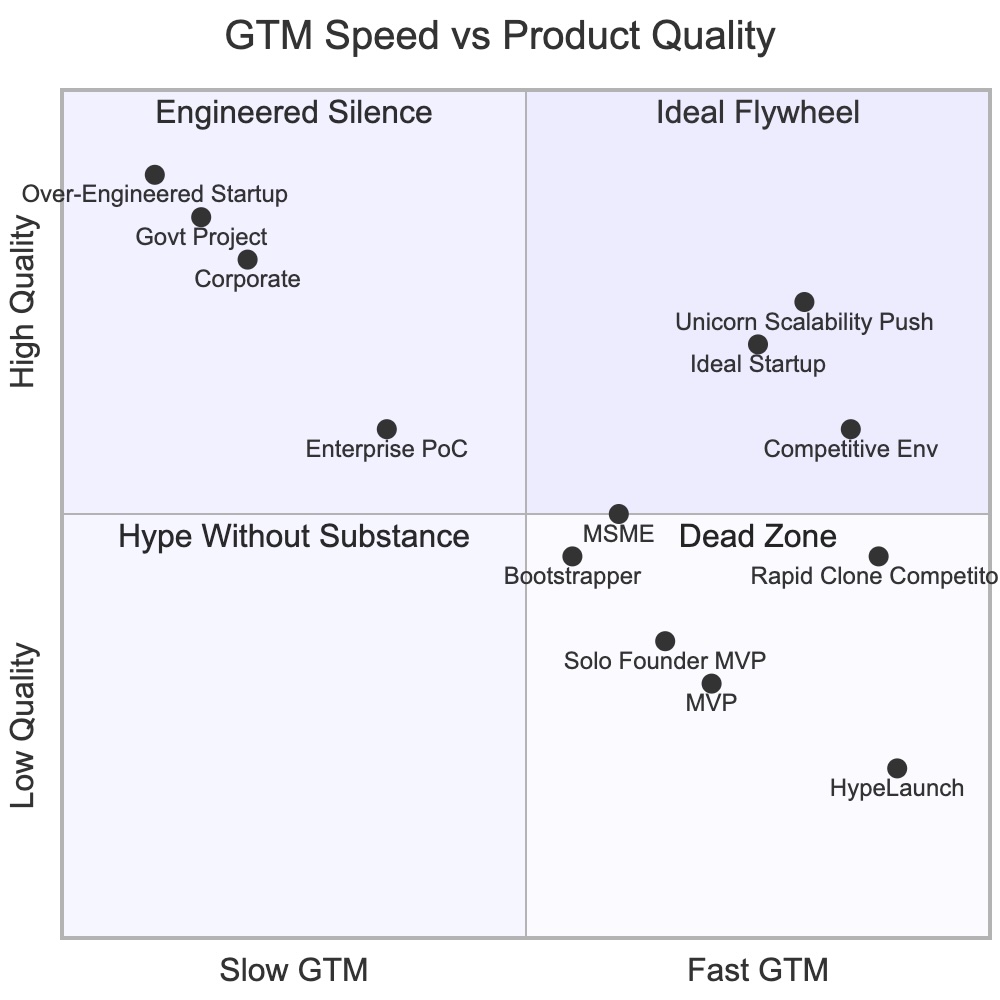
3. The Quadrant of Winners: Fast GTM × Rising Product Quality
The products that sell live in the upper-right quadrant:
- Fast GTM: because speed reduces uncertainty
- High enough quality: because trust is earned, not claimed
The New York Times often frames success not as a binary outcome, but as a balance of tensions:
“The winners were those who managed to move quickly without collapsing under the weight of their own ambition.”
AxonOS makes this balance achievable:
- Nodes are versioned
- Workflows evolve without breaking contracts
- Deployments are instant
- You ship without DevOps friction
- You maintain quality with every iteration
- Rollbacks are painless
- Observability is built in
You don’t choose between speed and quality.
You operate at the intersection—where products truly sell.
4. The First “Moment of Value” Matters More Than Anything
Every product has a moment—an instant—where the user decides: “This makes my life easier.”
This is the moment the Times once described as “the sliver of clarity where technology stops being novelty and becomes necessity.”
To create this moment, you must deliver:
- Reduction in friction
- Reduction in steps
- Improvement in clarity
- A feeling of control
And you must deliver it early.
AxonOS accelerates this early win:
- Build functional prototypes in hours
- Show users real data flows
- Personalize node behavior instantly
- Enable real outcomes, not mockups
- Turn back-end logic into visual flows
- Deploy to UAT without overhead
When a user sees a workflow run end-to-end, even if partially manual behind the scenes, the moment of value is immediate and visceral.
That’s when products start to sell.
5. Why Most Teams Fail (And Where AxonOS Helps)
Most teams fail because they:
- Over-engineer too early
- Chase edge cases
- Build internal abstraction layers instead of user value
- Spend weeks doing DevOps plumbing
- Ship slowly
- Iterate even slower
The New York Times frequently highlights how the most innovative teams succeed simply because they “learn faster than the problem changes.”
AxonOS enables that fast learning by removing:
- Boilerplate development
- Infrastructure friction
- Deploy-time uncertainty
- Integration headaches
- Versioning conflicts
- Rollback risk
- Environment inconsistency
You’re not slowed down by the machinery of software.
You’re focused on discovering what matters.
6. The Anatomy of a Product That Sells (Checklist)
A. Solve a painful problem
If it doesn’t hurt, it doesn’t sell.
B. Deliver relief early
Your first 10 minutes matter more than your next 10 features.
C. Build as if observing a human story
NYT-style thinking:
What’s the narrative arc of your user’s day?
Where is the conflict, tension, release?
D. Reduce cognitive load
People buy simplicity, not complexity.
E. Iterate weekly
Monthly iteration is death.
F. Build trust through reliability
Quality is reputation.
G. Use a learning engine
This is where AxonOS shines.
It gives you the mechanics to:
- Learn in production
- Correct quickly
- Deploy safely
- Scale wisely
Products that sell do not stagnate.
They compound.
7. Conclusion: The Future Belongs to the Fast Learners
The best description of breakout products came from a NYT profile of early internet pioneers:
“They didn’t predict the future. They built it, tested it, rewrote it, and rebuilt it again—until reality bent to their persistence.”
Products that sell are built the same way:
- Fast
- Truth-first
- User-centered
- Reliable
- Iterative
- Scalable only when needed
And tools like AxonOS make this process not only possible but predictable.
When you combine:
- A painful problem
- A fast feedback loop
- High-enough product quality
- A scalable build system like AxonOS
- And the willingness to do things that don’t scale
You move into the rare territory where products begin selling even when you’re not in the room.
That’s the dream every founder is chasing.
That’s the power of building in the upper-right quadrant.
And that’s the promise of AxonOS.
What This Means for the Industry
We see this as a major step toward AI-native orchestration platforms. By aligning human-readable definitions with machine-executable workflows, we reduce friction, improve collaboration, and unlock entirely new possibilities for autonomous applications.
At Simtel.ai, we’re not just building tools — we’re building the language of the future for humans and machines to co-create software.
if you are interested, do checkout https://www.axonos.ai and use the free account to test your ideas!