
3 posts tagged with "AxonOS"

View All Tags

Products That Sell: Why Speed, Quality, and AxonOS Build Capabilities Create the Real Winners

· 6 min read
Ravi Kaushik
Founder @ Simtel.AI

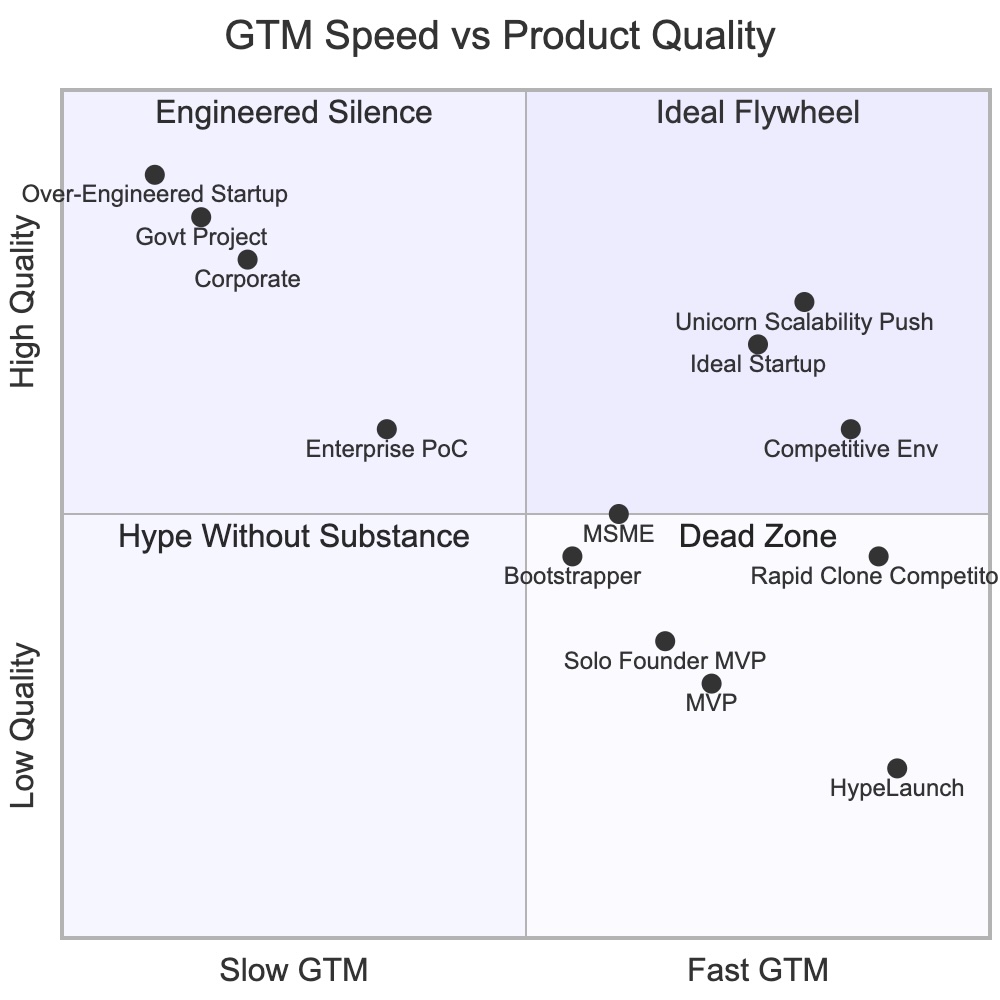
Product Shipping Quadrant

Walk into any startup war room—whiteboards dense with arrows, a half-erased roadmap, coffee rings on the table—and you’ll notice something quietly unsettling: the best ideas don’t always become the best products, and the best products don’t always become the ones that sell.

This isn’t a new discovery.
It’s the same paradox that has shaped every era of technology.
As the New York Times once described of early internet founders, “they weren’t selling software; they were selling the promise that tomorrow could be easier than today.”

Products that sell aren’t built purely on code.
They’re built on momentum, truth, velocity, and timing—and increasingly, on platforms like AxonOS, which let teams build, validate, iterate, and scale faster than the old rules ever allowed.

In this essay we explore what makes a “product that sells,” why most teams fail to reach that zone, and how AxonOS’s build capabilities help founders operate where it matters most: the fast lane of learning and value delivery.


1. Products That Sell Don’t Start Perfect—They Start True

The myth of the “perfect first release” is one of tech’s most persistent illusions.
Founders obsess over architecture.
Teams polish features endlessly.
Everyone waits for the mythical Version 1.0 that will—supposedly—carry the company.

But technology history tells a different story.

One New York Times profile on early consumer startups noted how the breakout successes shared a single trait:
“They understood something uncomfortable, unpolished and real about their users before anyone else did.”

Products that sell begin with:

  • A painful problem
  • A clear emotional trigger
  • A simple way to relieve the pain
  • A fast path to validation

And this is where AxonOS becomes a cheat code.

Instead of writing weeks of infrastructure code, you compose workflows, nodes, and integrations in a matter of hours. You take a raw idea and turn it into something clickable, explorable, demo-able, and most importantly—usable.

Truth becomes the foundation.
Speed becomes the amplifier.


2. PG Was Right (But Misunderstood): “Do Things That Don’t Scale”

Paul Graham’s famous essay echoed something that NYT journalists often admire in early innovators: unreasonable proximity to the customer.

But PG’s advice is almost always misinterpreted.

Most people think it means:

“Move fast. Ship messy. Scale later.”

That’s not what he meant.

What he meant aligns closely with how the Times describes successful early movers:
“They built by hand what others tried to automate too soon.”

PG’s real message:

  • Talk to users directly
  • Hardcode early behaviors
  • Deliver value manually
  • Understand the emotional weight of the problem
  • Then scale the correct system

AxonOS is practically built around this ethos:

  • Build unscalable logic quickly
  • Test workflows on real environments
  • Gather feedback instantly
  • Refine without fear
  • Scale workflows only after correctness is validated

It’s the PG loop—but with power tools.


3. The Quadrant of Winners: Fast GTM × Rising Product Quality

The products that sell live in the upper-right quadrant:

  • Fast GTM: because speed reduces uncertainty
  • High enough quality: because trust is earned, not claimed

The New York Times often frames success not as a binary outcome, but as a balance of tensions:
“The winners were those who managed to move quickly without collapsing under the weight of their own ambition.”

AxonOS makes this balance achievable:

  • Nodes are versioned
  • Workflows evolve without breaking contracts
  • Deployments are instant
  • You ship without DevOps friction
  • You maintain quality with every iteration
  • Rollbacks are painless
  • Observability is built in

You don’t choose between speed and quality.
You operate at the intersection—where products truly sell.


4. The First “Moment of Value” Matters More Than Anything

Every product has a moment—an instant—where the user decides: “This makes my life easier.”

This is the moment the Times once described as “the sliver of clarity where technology stops being novelty and becomes necessity.”

To create this moment, you must deliver:

  • Reduction in friction
  • Reduction in steps
  • Improvement in clarity
  • A feeling of control

And you must deliver it early.

AxonOS accelerates this early win:

  • Build functional prototypes in hours
  • Show users real data flows
  • Personalize node behavior instantly
  • Enable real outcomes, not mockups
  • Turn back-end logic into visual flows
  • Deploy to UAT without overhead

When a user sees a workflow run end-to-end, even if partially manual behind the scenes, the moment of value is immediate and visceral.

That’s when products start to sell.


5. Why Most Teams Fail (And Where AxonOS Helps)

Most teams fail because they:

  • Over-engineer too early
  • Chase edge cases
  • Build internal abstraction layers instead of user value
  • Spend weeks doing DevOps plumbing
  • Ship slowly
  • Iterate even slower

The New York Times frequently highlights how the most innovative teams succeed simply because they “learn faster than the problem changes.”

AxonOS enables that fast learning by removing:

  • Boilerplate development
  • Infrastructure friction
  • Deploy-time uncertainty
  • Integration headaches
  • Versioning conflicts
  • Rollback risk
  • Environment inconsistency

You’re not slowed down by the machinery of software.
You’re focused on discovering what matters.


6. The Anatomy of a Product That Sells (Checklist)

A. Solve a painful problem

If it doesn’t hurt, it doesn’t sell.

B. Deliver relief early

Your first 10 minutes matter more than your next 10 features.

C. Build as if observing a human story

NYT-style thinking:
What’s the narrative arc of your user’s day?
Where is the conflict, tension, release?

D. Reduce cognitive load

People buy simplicity, not complexity.

E. Iterate weekly

Monthly iteration is death.

F. Build trust through reliability

Quality is reputation.

G. Use a learning engine

This is where AxonOS shines.
It gives you the mechanics to:

  • Learn in production
  • Correct quickly
  • Deploy safely
  • Scale wisely

Products that sell do not stagnate.
They compound.


7. Conclusion: The Future Belongs to the Fast Learners

The best description of breakout products came from a NYT profile of early internet pioneers:
“They didn’t predict the future. They built it, tested it, rewrote it, and rebuilt it again—until reality bent to their persistence.”

Products that sell are built the same way:

  • Fast
  • Truth-first
  • User-centered
  • Reliable
  • Iterative
  • Scalable only when needed

And tools like AxonOS make this process not only possible but predictable.

When you combine:

  • A painful problem
  • A fast feedback loop
  • High-enough product quality
  • A scalable build system like AxonOS
  • And the willingness to do things that don’t scale

You move into the rare territory where products begin selling even when you’re not in the room.

That’s the dream every founder is chasing.
That’s the power of building in the upper-right quadrant.
And that’s the promise of AxonOS.

What This Means for the Industry

We see this as a major step toward AI-native orchestration platforms. By aligning human-readable definitions with machine-executable workflows, we reduce friction, improve collaboration, and unlock entirely new possibilities for autonomous applications.

At Simtel.ai, we’re not just building tools — we’re building the language of the future for humans and machines to co-create software.

if you are interested, do checkout https://www.axonos.ai and use the free account to test your ideas!
A Patent on AxonOS AI-Native platform, where you can orchestrate intelligent workflows

· 3 min read
Ravi Kaushik
Founder @ Simtel.AI

Application Filed: A SYSTEM AND METHOD FOR AI-ASSISTED APPLICATION DEVELOPMENT PLATFORM USING A DEFINITION LANGUAGE

At Simtel.AI, we believe the next generation of software will be built not just by humans, but in collaboration with intelligent systems. Our latest invention — an AI-assisted application development platform using a definition language (DL) — addresses long-standing challenges in software engineering, making development faster, more secure, and more scalable.

Why We Built This

Traditional software development relies on hand-written source code, framework-specific tools, and disconnected orchestration systems. Even with low-code and no-code platforms, developers struggle with:

  • Fragmentation: Visual design tools, source code, and execution logic are often out of sync.
  • Scalability gaps: Current platforms lack persistent AI agent memory, dynamic orchestration, and robust credential management.
  • Limited AI integration: AI is usually bolted on, not embedded as a core design principle.

The result? Redundant work, brittle workflows, and difficulty scaling AI-native applications.

Our Approach: Definition Language (DL)

We introduce a JSON-based definition language that acts as a single source of truth. It’s readable by humans, executable by machines, and editable by AI models. This unified specification brings together inputs, outputs, credentials, execution logic, source code, and UI — eliminating silos.

Key capabilities include:

  1. Executable JSON Node Templates – Standardized building blocks for workflows, validated with AI guardrails.
  2. Bi-directional Visual & Code Sync – Graphical workflows always stay aligned with JSON specifications.
  3. Secure Credential Resolution – Zero-knowledge architecture ensures secrets are never exposed.
  4. AI-Driven Workflow Generation – Large language models can generate, debug, and refactor workflows in real-time.
  5. Scalable Deployment – Workflows become containerized microservices or API endpoints ready for cloud, edge, or on-prem.

Inside the Platform

Our system brings together several powerful modules:

  • AI Agentic Module: Defines capabilities in DL-based JSON.
  • Node Builder & Explorer: Lets developers and AI co-create functional units.
  • Flow AI Workspace: Translates high-level goals into DAG-based workflows.
  • Orchestration & Deployment Engine: Converts workflows into containerized applications with monitoring, testing, and governance built-in.

By combining these, developers, startups, and enterprises can build applications with greater speed, reliability, and compliance.

Benefits for the Future of AI-Native Software

  • Faster Iteration: Visual and AI-assisted tools reduce development cycles.
  • Stronger Security: Credential vaulting and schema validation enforce safety by design.
  • True AI-Native: Agents retain memory, execute complex orchestration, and self-improve over time.
  • Enterprise-Ready: Compliance, governance, and certification are embedded into the workflow.

What This Means for the Industry

We see this as a major step toward AI-native orchestration platforms. By aligning human-readable definitions with machine-executable workflows, we reduce friction, improve collaboration, and unlock entirely new possibilities for autonomous applications.

At Simtel.ai, we’re not just building tools — we’re building the language of the future for humans and machines to co-create software.

Introducing AxonOS: The 7 Layers of Intelligence

· 6 min read
Ravi Kaushik
Founder @ Simtel.AI

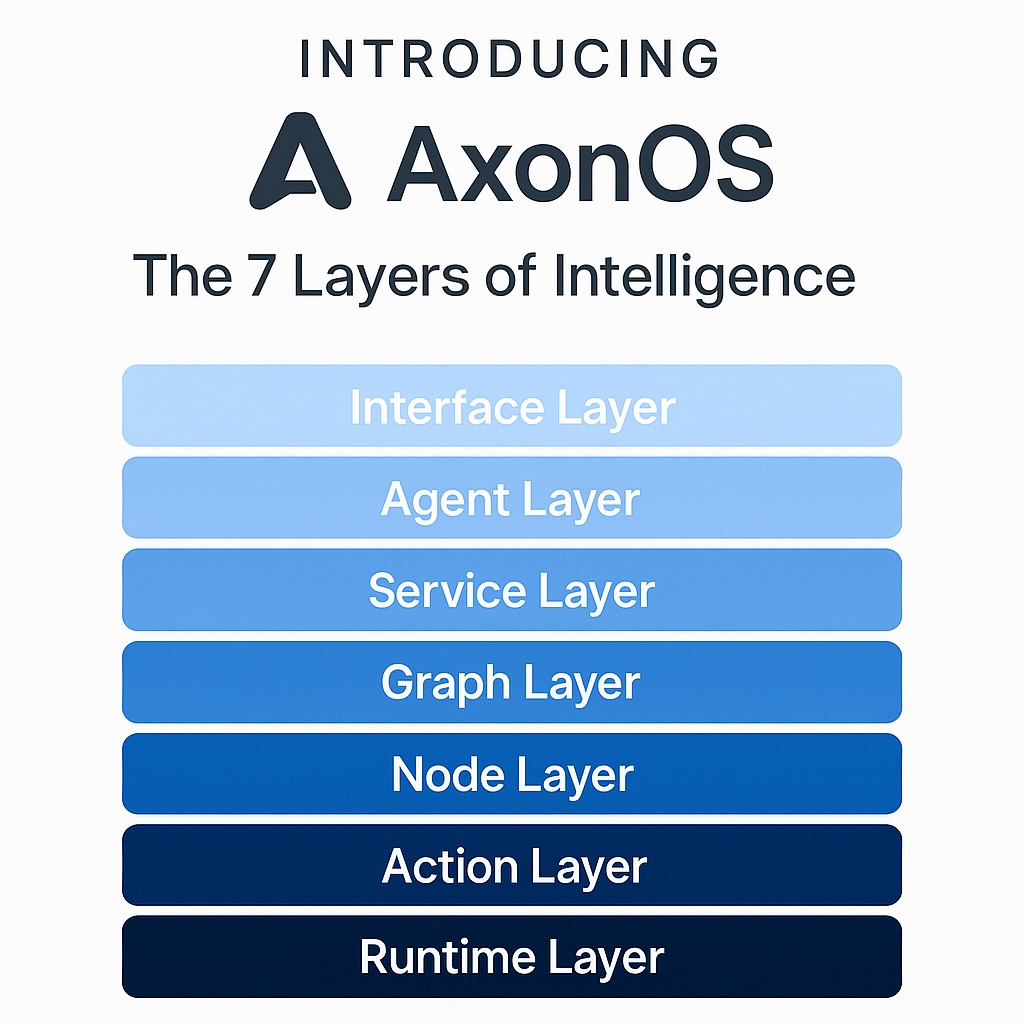
AxonOS Architecture

At Simtel.AI, we believe the future of software isn't just about automation—it's about intelligence that adapts, composes, and evolves.

That's why we're building AxonOS, a modular operating system for orchestrating intelligence. Not just another workflow engine or LLM wrapper, AxonOS introduces a powerful layered design that brings human intention, AI reasoning, and executable logic into a single, unified framework.

Why Layers?

Modern software is bloated. It entangles data, execution, AI, and user interfaces into rigid stacks that don't scale with complexity or abstraction. We reimagined this—from the bottom up.

AxonOS is designed as a 7-layer stack, where each layer plays a distinct role in building, operating, and evolving intelligent systems.

Without going into proprietary details, here's a high-level look:

1. Action Layer – The Foundation of Execution

The raw execution units. These are the smallest, testable, sandboxed functions that do real work.

  • Atomic Operations: Each action performs a single, well-defined task
  • Sandboxed Execution: Isolated runtime environments prevent interference
  • Composable by Design: Actions can be combined into more complex operations

2. Node Layer – Building Blocks of Logic

Composable logic blocks. Nodes define clear inputs, outputs, and configuration—executable across runtimes.

  • Type-Safe Interfaces: Clearly defined input/output contracts
  • Runtime Agnostic: Execute in containers, serverless, or local environments
  • Configuration Driven: Parameterizable behavior without code changes

3. Graph Layer – The Flow of Intelligence

The flow of logic and data. Graphs (or "Nets") connect nodes based on dependency, data flow, and control structure.

  • Dependency Management: Automatic resolution of execution order
  • Data Flow Optimization: Efficient routing of information between nodes
  • Control Structures: Support for conditionals, loops, and parallel execution

4. Service Layer – Deployment and Exposure

Microservices that can expose graphs, nodes, or actions via APIs or schedules. Deployable anywhere.

  • API Generation: Automatic REST/GraphQL endpoint creation
  • Scheduling Support: Cron-like execution for batch operations
  • Multi-Protocol: HTTP, gRPC, WebSocket, and message queue interfaces

5. Agent Layer – Autonomous Decision Making

The decision-making layer. Where goals, memory, and tool selection begin to act autonomously.

  • Goal-Oriented Behavior: High-level objective decomposition
  • Memory Systems: Context retention across interactions
  • Tool Selection: Dynamic choice of appropriate actions and nodes

6. Interface Layer – Human-AI Interaction

Where humans meet the system. Think of it as the agent's skin: UI components, prompts, APIs, chats.

  • Multi-Modal Interfaces: Text, voice, visual, and programmatic access
  • Dynamic UI Generation: Context-aware interface adaptation
  • Prompt Engineering: Integrated natural language processing

7. Runtime Layer – Orchestration Engine (Optional)

A pluggable orchestration engine that powers execution, tracing, scaling, and caching.

  • Execution Orchestration: Distributed processing coordination
  • Observability: Real-time monitoring and debugging
  • Auto-Scaling: Dynamic resource allocation based on demand

Built for the New Stack

AxonOS isn't built for static codebases or cloud vendor lock-in. It's built for:

  • Tool Use + Reasoning: Seamless integration of AI decision-making with tool execution
  • Visual + Prompt-Based Programming: Both graphical interfaces and natural language programming
  • Rapid API + Container Deployment: One-click deployment to any infrastructure
  • Observability Across Logic + AI Decisions: Full traceability from user intent to execution
  • Open Integration with OSS Tools: Compatible with existing open-source ecosystems

What Can You Do With It?

Build Composable AI Systems

Create intelligent systems that span code, tools, APIs, and agents without vendor lock-in or rigid frameworks.

Deploy Intelligence Modules

Package and deploy reusable "Intelligence Modules" anywhere: API endpoints, scheduled jobs, containers, or distributed node networks.

Mix Declarative and Imperative Logic

Combine structured programming with fuzzy AI reasoning—let the system choose the best approach for each task.

Host Your Own AI Runtimes

Maintain full control over your AI infrastructure with built-in governance, explainability, and observability.

The Architecture Advantage

Traditional software architectures force you to choose between:

  • Rigid Structure vs Flexible Intelligence
  • Deterministic Behavior vs Adaptive Learning
  • Human Control vs AI Autonomy

AxonOS eliminates these false choices. Each layer provides specific capabilities while maintaining clean interfaces with adjacent layers. This allows for:

  • Gradual Intelligence: Start with simple automation, evolve to full autonomy
  • Selective AI: Apply AI reasoning only where it adds value
  • Human Override: Maintain control while leveraging AI capabilities

Use Cases and Applications

Enterprise Automation

  • Intelligent Document Processing: Extract, validate, and route documents with AI-powered decision making
  • Customer Service Orchestration: Combine rule-based routing with AI-powered response generation
  • Supply Chain Optimization: Dynamic planning that adapts to real-time conditions

Development and DevOps

  • Intelligent CI/CD Pipelines: Self-optimizing deployment workflows
  • Automated Code Review: AI-assisted quality assurance with human oversight
  • Infrastructure Management: Adaptive scaling and self-healing systems

Data and Analytics

  • Automated Data Pipelines: Self-configuring ETL processes
  • Intelligent Monitoring: Proactive alerting with contextual recommendations
  • Dynamic Reporting: AI-generated insights with human validation

Coming Soon

We'll be opening up early access to the AxonOS sandbox and our open protocol (ADL) for describing intelligent systems.

What to Expect:

  • Interactive Sandbox: Experiment with AxonOS layers in a browser-based environment
  • ADL Protocol: Open specification for describing intelligent system architectures
  • Community Tools: Open-source components and integrations
  • Developer Resources: Comprehensive documentation, tutorials, and examples

Join the Beta

Ready to experience the future of intelligent systems? Register for early beta access and be among the first to build with AxonOS.

Beta participants will get:

  • Priority Access: First to try new features and capabilities
  • Direct Feedback Channel: Shape the development with your insights
  • Exclusive Resources: Advanced tutorials and use case examples
  • Community Access: Connect with other beta developers

Until then, follow us as we unfold how agents, logic, and interfaces are merging into the next fabric of computing.

Get Involved

Website: https://axonos.ai
Sandbox: https://sandbox.axonos.ai (coming soon)
Twitter/X: @SimtelAI
Documentation: https://docs.axonos.ai (coming soon)
Simtel.AI: https://simtel.ai


Intelligence isn't a feature. It's a structure. And it's time to build it right.

The future of software is intelligent, modular, and human-centric. AxonOS is designed to make that future accessible to every developer, every organization, and every human working with AI.

Join us at Simtel.AI in building the operating system for the age of intelligence.